Wednesday, April 20, 2011

Caddo Lake National Wildlife Refuge

We went back to the Caddo Lake NWR this morning. We wanted to walk part of the 8 mile trail. Unfortunately, it was very muggy and warm this morning and not very comfortable to be outside. We did see a beautiful Red-headed Woodpecker, several Blue Grosbeaks and a large group of Cedar Waxwings.


Blue Grosbeak (Guiraca caerulea)
The female lays 3-5 pale blue to bluish white eggs. The young leave the nest about 9-10 days after hatching.


Cedar Waxwing (Bombycilla cedrorum)
These birds are very sociable, and it is rare to see just one.


Three-toed Box Turtle:
Don’t depend entirely on the toes, it sometimes has four!


Grasshopper emerging

Grasshoppers develop by gradual metamorphosis and undergo six to ten molts before reaching maturity. We came across a group of immature grasshoppers and actually saw several that had just molted from one state to the next.

We have really enjoyed our short stay here at Caddo Lake. Tomorrow we're leaving Texas.

Tuesday, April 19, 2011

Canoes and Pontoons

This morning we rented a canoe here in the park and paddled around Caddo Lake.
Caddo Lake covers a 32,700 acre maze of channels, meandering bayous, and sloughs within thousands of acres of Baldcypress trees.


Baldcypress (Taxodium distichum)


Making our way through the cove to the main channel


Mark is a very good navagator!


Out in the main channel

Many beautiful aquatic plants are in and on the surface of the water.
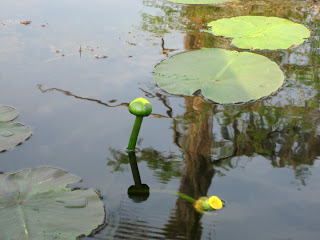

Spatterdock (Nuphar luteum)

Some of the birds didn’t recognize us as human so we were able to get very close. I guess we look like a large floating log!


Little Blue Heron (Egretta caerulea)

After our canoe trip we drove into the little town of Jefferson for lunch. Situated on Big Cypress Bayou, Jefferson early became a riverport town, and, in fact, has been described as the "Riverport to the Southwest." The boats came up the Mississippi River into the Red River, through Caddo Lake, and up Big Cypress to what was known as the "Turning Basin" where the stern-wheelers loaded and unloaded cargo. One of the early settlers of Jefferson was Captain William Perry, owner/builder of the world famous Excelsior Hotel, who arrived with the first stern-wheeler in 1844.

Then we headed to Uncertain to take a pontoon boat trip. We wanted to go on the Graceful Ghost Steamboat but the winds were too strong so we had a pontoon boat ride instead. Our captain (Ron) was very entertaining and knowledgeable about the history of Caddo Lake, Uncertain, and Jefferson. It was a very enjoyable 1 1/2 hours.


The Graceful Ghost Steamboat. The only remaining wood-fired operating steamboat in the US.


Government Ditch. A channel dredged for steamboats that supposedly cut 2 days off the trip from Shreveport, LA to Jefferson, TX.


River Cooter


10' Alligator

Monday, April 18, 2011

Bullets to Birds


Please click on the above picture to read the fascinating history of the Longhorn Army Ammunition Plant

We visited the Caddo Lake National Wildlife Refuge today. It was formerly the Longhorn Army Ammunition Plant. We didn’t know a lot about this Refuge before today but we found the story about the ammunition plant fascinating.

On September 9, 1988, Longhorn played a significant role in history when it was the site where the first U.S. missiles were destroyed as a part of the U.S. and Soviet INS (Intermediate-range Nuclear forces) treaty.


Rocket Motor displayed at the Visitor Center

The Caddo Lake National Wildlife Refuge was opened to the public on September 26, 2009.

We followed the auto tour road that is one of the original roads through the ammunition plant. It was a nice drive into the area where we could still see evidence of the ammunition plant. As far as we could tell, we were the only visitors in the Refuge.


Ammunition Magazine

Several of the signs and the ammunition magazines are still along the roads.

(Ammunition magazines are large, above-ground, earth-covered bunkers used to store munitions at almost all military facilities.)


Click to enlarge

A primary factor in establishing the Caddo Lake National Wildlife Refuge was to ensure the conservation and protection of migratory and resident waterfowl and neotropical migratory birds associated with Caddo Lake wetlands.

Studies have listed up to 224 species of birds, 22 species of amphibians, 46 species of reptiles, and 93 species of fish in this area.


Blue Grosbeak


Carolina Wren


Orchard Oriole


Red-eyed Vireo


Lanceleaf Coreopsis


Crimson Clover

Sunday, April 17, 2011

Caddo Lake State Park, Texas

On the road again ...

Our first stop on our Spring/Summer trip is Caddo Lake State Park and Wildlife Management Area in Northeast Texas (14 miles northeast of Marshall.

In 1933, Mr. T.J. Taylor (better known as Ladybird Johnson’s father), and other land donors contributed property for the development of the first National Park Service-supervised state park in Texas. The CCC (Civilian Conservation Corps) developed Caddo Lake State Park between 1933 and 1937.

Mark and I have been here once before (in April of 2007). It’s a beautiful area with lots of big pine trees.


VERY tall Pine Trees

We’ve already gotten a lifer - Fish Crow. I don’t know how we missed it before but it was fun to hear (it sounds like a crow calling through a kazoo!). It’s smaller than an American Crow with smaller bill and feet.

Our RV site is a very large pull-through that is really nice.


Site # 19

We went on a short hike after dinner.


Mark on one of the hiking trails


Caddo Lake

Mark will bust out the big camera tomorrow and we’ll do a lot more exploring.

Thanks for following along as we slowly make our way to Aroostook State Park in Maine.

Tuesday, April 12, 2011

We are not fast


We found this insightful sign at a wonderful little place in Medina called “The Apple Store”. Besides being a cafĂ© and gift shop, they also sell many different kinds of apple trees. Medina is recognized as the capital of the Texas apple industry.


Dwarf apple trees for sale


Lots of apple related jams and jellies

We stopped in this morning for breakfast where we both tried the, hot from the oven, apple turnovers. Yum! They were good to the last crumb.


You need both hands to hold one of the enormous, hot, apple turnovers!


Mark enjoying his turnover (chocolate chip cookie too!) on the patio.

We decided to spend a couple of days at our new little place in Medina. The previous owner had named our place “Dos Oaks”. We really like it out here. It’s in the beautiful Texas Hill Country and is surrounded by hills. The crystal clear Medina river is close by.


Dos Oaks

Monday, April 11, 2011

Gull-bill Tern

From Lives of North American Birds by Kenn Kaufman:

Besides the thick bill that gives it its name, this tern has a relatively stocky build and broad wings. Typically seen in leisurely flight over marshes, hawking for insects in the air or swooping down to take prey from the water or the ground; unlike typical terns, rarely dives into water for fish. On the ground, walks better than most terns.


Nests mostly on beaches and islands. Reportedly used to nest more often in salt marshes, abandoned those sites because of human persecution.

Feeds on a wide variety of insets caught on the ground, in the air, or at the surface of the water. Also feeds on spiders, crabs, shrimp, mollusks, earthworms, small fish, frogs, etc. Forages by flying slowly into the wind, dipping to surface of land or water to pick up items, or by catching flying insects in the air. Sometimes forages while walking on the ground; rarely plunges into water.


Gull-billed Terns are colonial breeders. Colonies are usually small, not as densely packed as those of many terns. The nest is on open ground. The nest (built by both sexes) is a shallow depression, often with rim of soil and the addition of some plant material and debris. Usually 2-3 eggs. Incubation is by both parents for 22-23 days. The young leave the nest a few days after hatching and move to dense plant cover if nearby. Age at first flight is 4-5 weeks. The young may remain with parents 3 months or more, beginning southward migration with them.

Mainly a summer resident in California and on Atlantic coast; some remain through winter on Gulf coast. Evidently far less numerous on the Atlantic coast today than it was historically. Human disturbance and loss of nesting sites among likely causes. Has begun nesting on rooftops in some Gulf coast areas.


With frog!

Mark took these pictures at Estero Llano Grande.

Friday, April 8, 2011

Eastern Screech Owl (Otus asio)

As we were walking down the entrance path at Estero Llano Grande State Park, Mark looked up and saw this wonderful sight!


This Eastern Screech Owl was just hanging out, looking around. Isn’t he super cute?!

The great story we heard is that, while the park staff was putting this nest box in the tree, this little guy came out of a hole in a nearby tree and waited for the humans to leave. As soon as they did, he made this his new home!

This robin-sized owl spends the day roosting in holes or in dense cover, becoming active at dusk. Despite the name, screech-owls do not screech; the voice of this species features whinnies and soft trills.