Saturday, November 7, 2015

Fulton Mansion

Teri and I have been visiting the Rockport/Fulton area for over twenty years, yet we'd never taken the time to visit the Fulton Mansion. During our latest visit to the area we had a cool, rainy day that kept us from our planned outdoor activities, and we decided that it was time for that visit.

George Fulton was an engineer, inventor, and ranching entrepreneur. Fulton was married to Harriet Smith, and it was her land inheritance on Aransas Bay that they developed into a ranching and meatpacking empire called the Coleman-Fulton Pasture Company.

Fulton Mansion - Front
To symbolize their success they designed and built what was then known as Oakhurst, completing construction in 1877. It is considered one of the finest examples of French Second Empire domestic architecture, and was the only home in the area with gas lighting, central heating, and indoor plumbing.
Fulton Mansion - Rear
For our tour we entered through the back of the mansion, and were immediately impressed by the condition. Everything was freshly painted and in perfect shape. Once inside we learned that the mansion had been closed for the previous two years and had undergone a $3.4 million dollar restoration. It re-opened less than two weeks prior to our visit. How's that for timing?

Many of the original furnishings and fixtures have been returned to the mansion, with other correct period pieces purchased to fill the gaps. The rooms were stuffed full of furniture, which we were told was a sign of affluence at the time. 
Parlor
Hot and cold running water was a unique feature of the home, and the bathroom featured a large copper-lined bathtub. It also had this curious piece of furniture. Care to guess what it is??
Mystery Appliance
A hint:
Onion Skin Toilet Paper
Yes, that is the state-of-the-art indoor toilet. Fancy!!

The Fulton's lived in the home for only 18 years, after which it continued to be used as a private residence, then a restaurant, and finally an RV park. There are some amazing pictures of travel trailers parked on the grounds between the mansion and Aransas Bay, with the dilapidated home standing in the background. Texas Parks & Wildlife acquired the property in 1976, with transfer to the Texas Historic Commission in 2008.
"Original" Room
One of the upstairs rooms was not restored, which allowed us to see damaged and exposed areas of the structure. It was an interesting look at the materials and methods used to build the mansion. You may also note that the plaster walls are covered with signatures. During its "neglected" years the mansion was apparently treated as a curiosity by visitors who explored the rooms and left their signatures on the wall. 

Oyster Shell Insulation
A curious building material used in the home was oyster shell for insulation. I don't know how good the insulating properties are, but there is a trap door that allows you to see oyster shell insulation between the first and second floors. 
Master Bedroom
We are happy that we finally took the time to visit the Fulton Mansion, and that we got to see it after the extensive renovation. An interesting part of Texas History to be sure.

Mark

Wednesday, November 4, 2015

What Kind Of Cake Do You Like?

Are you visualizing chocolate cake with a rich, creamy frosting?  Or maybe carrot cake with cream cheese frosting or spice cake or angel food cake, or ...

Do you know what my favorite cake is?  Yarn cake!!  Ever heard of it?

We’re having a dreary, misty day so I decided to spend the morning doing one of my favorite past times - getting out all my yarn and organizing it. 

I don’t have nearly enough yarn!

At the beginning of the year I had 5 of these large tubs stuffed full of yarn along with bags of yarn in the closet and underneath the couch.  While in Florida this past winter I had to order quite a bit of yarn to finish up some afghans I was working on.  Now I’m down to 2 full tubs, a tub with ‘scrap yarn’ and a couple of bags with yarn that I’m using right now. 

So, what is a yarn cake?  A few years ago I bought a yarn winder.  It’s great for winding partial skeins of yarn.  It keeps them neat and tidy.  The wound yarn is called a yarn cake! 

I’ve separated all my yarn by color, weighted all my yarn cakes so I know how much of each color I have, made a list of colors and amounts, and got it all back in the tubs.  It was a fun morning!
We’ve got a wonderful craft store in Kerrville that carries all the yarn colors I need.  So, right now, I’m not worried about stocking up, there is yarn close! 

I’m working on a couple of afghans now that I will finish before the end of the year.  That will make 22 afghans that I’ve crocheted and donated this year. 

Here are a few I’ve finished recently: 
Jacob's Ladder - scrap afghan.  
A scrap afghan is an afghan made out of left over bits and pieces of yarn from other projects. 
Shell stitch - also a scrap afghan 
Scooby-Doo.  This is calld a graphghan or picture afghan.
I got a little sidetracked but there will be more "vacation" blogs coming soon!
Teri

Sunday, November 1, 2015

The Aquarium at Rockport Harbor - Part 2

Even though this is quite a small aquarium, there are lots of interesting and unusual fish to see! 
Aquarium at Rockport Harbor

These are Sharksuckers (Echeneis naucrates): 
They have a sucker on top of their heads to attach to anything that moves!  They are found attached to sharks, manta rays, turtles etc.  If you find yourself with one attached to you, push forward to remove!
Sharksucker
He’s not dead!  This is a Tripletail (Lobotes surinamensis): 

It often floats on its side at the water's surface, the coloration and movements resembling that of a dead leaf. They are frequently mistaken for floating debris.  They normally weight from 5 to 15 pounds but have been found up to 50 pounds.
Tripletail 
The Texas state shell is the Lightning whelk (Busycon perversum pulleyi): 
Lightening Whelk.  State shell of Texas.

Lightning whelks are unusual in that they have a counterclockwise shell spiral (lightning whelks are usually called "left handed").

This 'left-handed' characteristic is reflected in the lightning whelk's scientific name perversum, from the Latin word perversus, means turned the wrong way. Busycon, from the Greek word bousycon, (meaning large fig) describes the general shape of the shell. The subspecies name, pulleyi, honors Dr. T. E. Pulley, a well known Texas naturalist and teacher.  Its common name is derived from patterns of "lightning-like" colored stripes that radiate along the sides of its shell.

Females enclose each fertilized egg into horny disc-shaped capsules while constructing a tough cord-like membranous egg-case string, which connects 50 to 175 total egg capsules. 
Egg capsules
Each flattened egg capsule can be as large as a quarter and contain as many as 200 eggs. The eggs hatch and the young mature through all larval stages within the capsules. Miniature whelks, with their shells, emerge through designated capsule ports during late spring. 


Baby Lightning Whelks

I don’t think I’ve ever wondered how shells reproduce!  It was really fascinating to see these tiny little shells. 

Next time - more tourist fun!
Teri

Friday, October 30, 2015

Road Trip

We’re on vacation.  What do you call it when you’re retired and you go on a trip?  Vacation doesn’t seem quite right.  Every day is a vacation when you’re retired!  Road trip sounds a little better.  I guess it doesn’t matter.  We’re not home, we’re not volunteering, and we’re not driving between volunteer locations.  So, road trip!

One of my favorite places in Texas is Rockport.  I love being around water.  

BR (before retirement) every year we would spend a week or so at Goose Island State Park in Rockport.  Usually we would come down here during the week of Thanksgiving.  Seems like back then we spent all our time bird watching.  We’d go out on Capt. Tommy’s boat, the Skimmer, to see the Whooping Cranes, and hit all the birding hot spots.  These days we don’t spend as much time birding and have enjoyed finding other tourist attractions. 
White Pelicans
There is a very small, but nice, aquarium in town that is only open 1-4pm, 5 days a week.  Entrance is free and there are enthusiastic volunteers waiting to answer questions and give helpful information.

A replica of the state-record blue marlin was donated to the aquarium last year.  It weighs in at 972.2 pounds and is approximately 11 feet long. 
State-record Blue Marlin

This cutie “Marley” is a Leopard Moray Eel.  Marley was donated to the aquarium after the local restaurant he lived in closed in 2011.  He’s about 5 feet long and is hand-fed shrimp and fish.  Every 3 days he gets his favorite meal, mahi-mahi.  Donated by the local HEB.
Marley
This Orange Filefish (Aluterus schoepfii) can be found at depths of 3,000 feet.  It often drifts in sea grass with its head pointed down to camouflage itself.
 
Orange Filefish
The Lookdown fish (Selene vomer) is capable of making loud grunts with its swim bladder! 
Lookdown

The Gulf Toadfish (Opsanus beta) looks a lot like a rock.  The sign says they are not venomous, just ugly.  It is one of just a few fish that can make sounds loud enough for people to hear.
Gulf Toadfish
Always a favorite of mine, the Seahorse tank.  There are 54 species in the genus Hippocampus (hippos meaning “horse” and kampos meaning “sea monster”). 
Seahorse

Next time - a few more interesting fish and something you might not know about the Texas state shell!

Teri

Monday, October 12, 2015

Home Sweet Hot...

After about 4 weeks of exploring our way back to Texas, we've arrived  at our little spot in Medina. It seems that we didn't drag our feet quite long enough, as we are forecast to have a near-record high of 95 degrees today. Sheesh!

Teri and I decided to visit Lost Maples State Natural Area as they have been seeing a Rufous-capped Warbler, which is a very rare bird for the United States. We got there about 8:30 in the morning and hung around the bird blind where it had been seen for a bit. We didn't spot the warbler but we did see a Tarantula crawling around on a rock before it retreated underneath.
Tarantula
We were also entertained by Rock Squirrels. We saw two distinct color variations. Some were completely black while others were bi-colored, with black head and shoulders but reddish brown bodies. Teri found a reference that said the Big Bend variety are all black while the Hill Country variety are bi-colored. Who knew?
Rock Squirrel - Black
Rock Squirrel - Bi-colored
After striking out at the bird blind we decided to walk some trails. The beautiful Sabinal River flows through the park, along with some smaller creeks that drain into the river. We spotted this 2 inch long green leech in one of the creeks. It moved along the bottom by extending its body forward, grasping the bottom, and then pulling the rest of its body along. Interesting to watch, if a little creepy!
Leech
October is one of the best butterfly months in Texas, and we weren't disappointed. This California Sister put on a nice show for us. 
California Sister
We returned to the bird blind for a while, but the warbler was not to be found. There were plenty of different sparrows along with Carolina Chickadees, Black-crested Titmice, Northern Cardinals, and many of the other common birds of the Texas Hill Country. As we were leaving this Common Raven croaked "good-bye" to us. 
Common Raven
Once the weather cools off a bit we may return and do more hiking at Lost Maples. It's a great place to explore and enjoy nature.

Mark

Sunday, October 4, 2015

More Than Cars On The Highway

We’ve been on the road for a couple of weeks.  From Idaho we drove to Montana, then Wyoming, then Colorado, then Utah and now we’re back in Colorado.  Mark has enjoyed playing several disc golf courses and we’ve been playing tourist and seeing some interesting things.

We certainly didn't expect to see this herd of a few hundred sheep walking down the highway!
Herding sheep

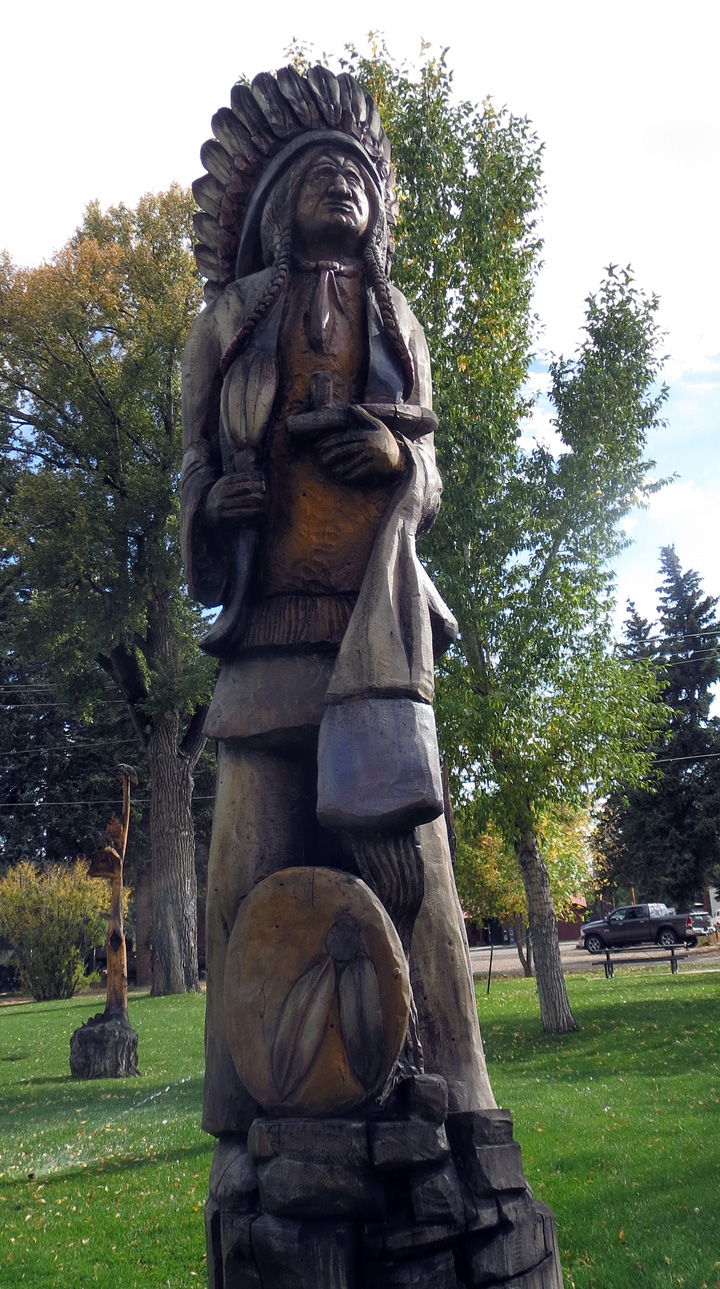
In Craig, Colorado we went on a self-guided carving tour of the Whittle The Wood competition.
 The competition started in 1999 to preserve the historic cottonwood trees in Craig City Park.  Large cottonwood logs are brought to the park for the competition.  

A select group of wood carvers are invited to the four-day festival that takes place every June.  After the festival the carvings are distributed throughout the city.
The brochure shows the placement of 94 carving locations.  We didn’t see all of them but the ones we did see were pretty incredible.


Back side of the gnome
The End!
Teri

Monday, September 28, 2015

Aerial Firefighting

After experiencing the wildfires in Northern Idaho this past summer and watching the airplanes used to fight those fires, we were pleased to find The Museum of Flight and Aerial Firefighting in Greybull, Wyoming.


This museum is located at the edge of the South Big Horn County Airport, which was formerly the base of operations of Hawkins & Powers Aviation. This company pioneered the use of heavy WWII era aircraft as aerial tankers for use in fighting wildfires. The airport was the busy operations center for this company which contracted with the US Forest Service to fight fires across the western US starting in the 1970's.
C-130A Dropping Fire Retardant
In 2002 two aerial tankers broke up in flight, killing the flight crews and destroying the aircraft. This led to USFS grounding the fleet and ultimately discontinuing the use of WWII aircraft as aerial tankers. Hawkins and Powers Aviation closed their doors and most of their aircraft and equipment were auctioned to cover debts.

There were a few planes left behind, and the museum was founded and staffed first by former Hawkins & Perkins employees and later by the Greybull Area Chamber of Commerce.
Flying Boxcar
Two of the planes on display are converted cargo planes designated C-119 but more widely known as the Flying Boxcar. The unusual plane had two tails to allow a large cargo loading door at the rear. One of the Flying Boxcars displayed has a jet engine mounted on top to increase power. Who'd have thought you could just bolt a jet engine on top of an old propeller driven plane and have it fly??
Flying Boxcar with Added Jet Engine
None of the planes on display are airworthy, and most are in an advanced state of deterioration. The Flying Boxcar had aluminum skin over most of the plane, but the control surfaces were fabric covered. Most of the fabric is now rotted away. 
Rotted Fabric on Tail
The two largest planes on display are the PB4Y-2, more commonly called Privateer. This was a modification of the B-24 bomber that saw widespread duty during WWII. 
PB4Y-2
This plane has four massive radial engines, and I'll bet it was really loud when they were all running. Looking into these engines they are so complicated that I'm amazed they ever all ran at once!
Huge Radial Engines
Beyond the museum fence is an aircraft boneyard where another twenty or so planes are sitting in various states of disrepair and disassembly. I guess this is the sort of place that you come if you need a hard-to-find part for your obsolete airplane. Kind of sad to see, but I suppose old planes have to sit somewhere.
Aircraft Boneyard in the Distance
So if you are an aircraft enthusiast or are interested in the history of aerial firefighting, make your way to Greybull, Wyoming and give this place a visit.

Mark