Monday, October 31, 2016

PLUH-VER or PLO-VER??

We have been on the Texas coast for a few days and are enjoying getting re-acquainted with the many shorebirds. Since we will be leading bird walks at Goose Island State Park for the next couple of months, we're making sure that we know all of their names.
Black-bellied Plover
One of the things we've run into when leading walks is different pronunciations of common bird names. We've had more than one participant insist that we're using an incorrect pronunciation when we understand that there is no single accepted way to say the name.

"Plover" is one example. There are several species of these plump little shorebirds that we'll see during our walks. Pronunciation seems about split between "Pluh-ver" and "Plo-ver".
Semipalmated Plover
We expect to see four different plover species on a regular basis. We'll identify them based on size (Black-bellied is much larger than the others), leg color (yellow/orange for Semipalmated and Piping, gray for Snowy), and back color (light gray for Snowy and Piping, darker brown for Semipalmated).
Piping Plover
But how to pronounce the names?? We've decided to go with "pluh-ver", and expect to hear about it!
Snowy Plover
So how about it birders? How do you pronounce "plover"??

Mark

Thursday, October 27, 2016

Leave Me Alone!!!

Teri and I have spent a few days at Inks Lake State Park. Not volunteering here this year, but it makes a nice stop to visit with family and friends.

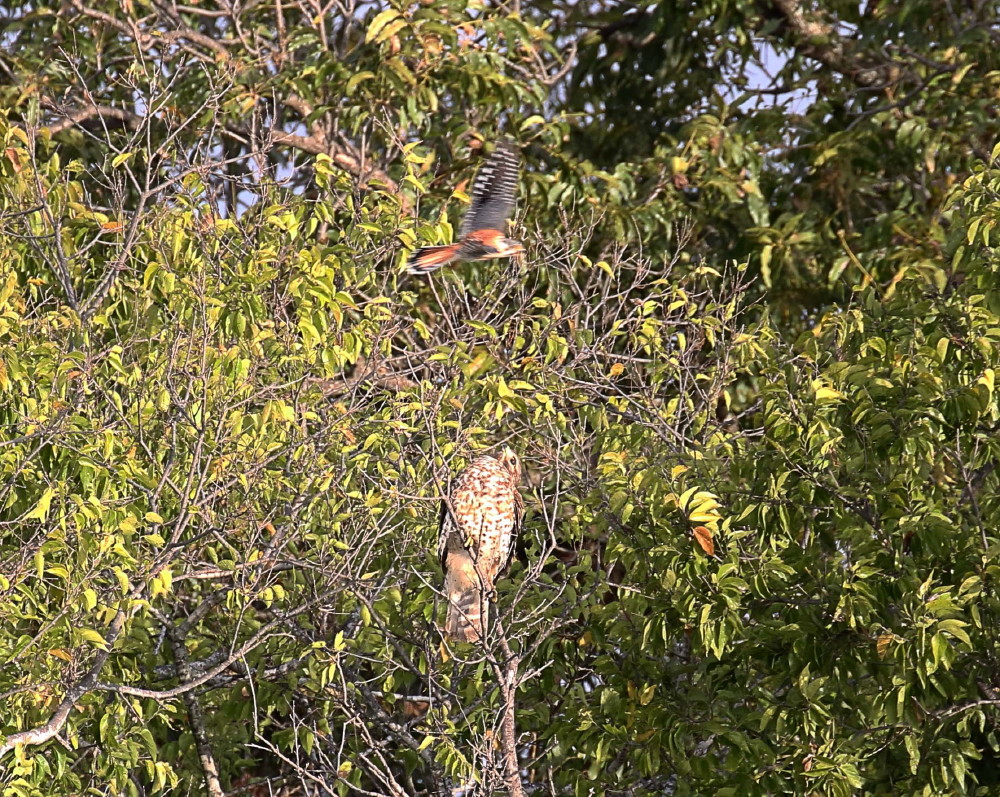
We spent a couple of hours at Inks Lake National Fish Hatchery looking for birds. The winter birds haven't really arrived yet so birding was slow, but we did witness an American Kestrel harassing a young Red-shouldered Hawk.

The poor hawk was perched in a tree minding its own business when a male Kestrel decided to start dive-bombing. It made about a dozen high-speed passes at the hawk while screaming and carrying on.
Where is it??
Incoming

It's hard to bend my head back this far...
 
The Kestrel will be back!
After about a minute of this, the hawk decided to find another place to rest. Mission Accomplished for the Kestrel.
Goodbye.
We're heading to the Texas Coast for a couple of months of volunteering. Stay tuned for plenty of Pelican and Duck pictures!

Mark

Tuesday, October 4, 2016

Back in Medina for a Bit

We haven't posted in a while, and that is because we left Leadville Fish Hatchery in mid-September and headed back to our "home base" in Medina, Texas. I needed to get some dental work underway, and we both needed to catch up on doctor, dentist, and eye exams before we head out again at the end of October.

We have had a chance to get out to the Hill Country State Natural area and a couple of the local nature centers. While the birds have been scarce the insects are more cooperative.

By far the most common butterflies in the area are American Snouts. They are flying by the hundreds of thousands, and getting hit by the thousands. The local car washes are doing a brisk business, as a 30 mile trip can net several hundred dead Snouts on your car!
American Snout
More colorful are these two tiny butterflies from the area. Neither is any larger than a fingernail.
Ceraunus Blue
Rounded Metalmark
The Cibolo Nature Center has a small marsh with a boardwalk that turned out to be a pretty good spot for dragonflies. The most colorful was this Roseate Skimmer.
Roseate Skimmer
Less colorful but more common were Common Whitetails.
Common Whitetail
And back home on our deck, this Praying Mantis was prowling around looking for a meal.
Praying Mantis
Hopefully we'll get some cold fronts and some birds shortly. But in the meantime we'll keep looking at what else is crawling about!

Mark

Sunday, August 28, 2016

Pop Goes the Weasel

We have seen a couple members of the weasel family here at Leadville National Fish Hatchery. American Martens (aka Pine Martens) live in the forest here, and we've been fortunate enough to see them a couple of times. But not fortunate enough to get a picture!!

Closer to our RV, we spotted a Long-tailed Weasel a week or so ago, but failed to get a picture. But as luck would have it I looked out this morning to see one perched on a boulder about 30' from our front door. GET THE CAMERA!!!

Long-tailed Weasel
These little guys are about 12" long and weigh around a half-pound. In winter they turn pure white, but keep the little black tip on their tail.

Hunting
There is lush grass surrounding the base of this boulder, and the weasel was clearly hunting.  This area is filled with mice, chipmunks, and ground squirrels, so these guys probably eat pretty well.
Where'd it Go??
The weasel took a sudden turn to its right and then jumped into the grass, but whatever it was hunting escaped (this time).

We'll keep our eyes peeled for a return appearance from this one!!

Mark

Thursday, August 25, 2016

Short Summer!!

Leadville, Colorado averages 26 frost-free days each year, and those have come and gone.  Mornings have been in the low 30's the past several days, and last night we saw a heavy accumulation of new snow up on the mountains.
Mosquito Range - New Snow
A closer look:

We don't know if this batch will stick or not, but we do know that more snow is certain to fall in the coming weeks. The local's aren't too thrilled to see their short summer coming to an end, but we love to see the snow on the mountains!


Mark

Monday, August 22, 2016

Boom Days

It seems like every Colorado tourist town has a summer festival, and Leadville is no exception. Boom Days celebrates Leadville's mining history with a street fair, parade, burro races, and contests of mining skill.

After a flyover by a plane from the Leadville airport, the parade started with a color guard and then plenty of bands, exhibits and a couple of floats.
Flyover
There were all sorts of different folks in the parade. This lady had a bicycle she has owned since 1955.
Original Owner
Ed, the hatchery manager is quite a craftsmen and has been building floats to compete in Boom Days Parade for several years. This year's theme was the Carlton Tunnel which is one of the many tunnels in the area. Ed started with a black plastic 55 gallon drum and created an amazing looking locomotive pulling an aquarium car out of the tunnel.
Friends of the Leadville Fish Hatchery
Friends of the Leadville Fish Hatchery led our float through the parade. They were wearing trout hats and handing out fish-shaped candy. Free candy was the big draw for the kids.
Leadville Fish Hatchery Float
Children of two of the refuge personnel rode in the float and had a great time. There were only a couple of other floats in the parade, and it was no contest as far as awarding "Best Float". Ed's locomotive won easily. 

One thing that you won't see in most small town parades is a marijuana van! With recreational usage being legal there are marijuana businesses all over Colorado, marked by a green cross. Several folks called out for free samples, but they weren't providing any!!
"Natures Medicine"
The most entertaining group was marching with a local cookie company. These teenagers were running around in dinosaur costumes and keeping the kids entertained. I don't know how they could see where they were going.
Watch Out for the Dinosaurs!
An entertaining duo was this pair of ladies representing a local saloon. They were really hamming it up and seemed to be enjoying themselves. 
Saloon Gals
When was the last time you saw someone riding a unicycle?? There was a group of several kids riding in the parade, and this young man wins the prize for the tallest!
One Tall Unicycle
It was a fun little festival, and we were glad to see the hatchery float take home the big prize!
Mark

Saturday, August 6, 2016

Spawning Cutthroat Trout

One of the ongoing activities from June through mid-July was the spawning of the Cutthroat Trout here at the hatchery. Spawning took place on a weekly basis, since not all of the fish were "ripe" at the same time. We assisted with spawning six different times, but didn't get a lot of pictures as we were busy!!

In simple terms, the ripe females have their eggs squeezed out of them by a biologist, and then the eggs are fertilized by milt that is squeezed from a male or males.
Squeezing Eggs from Female
The biologists separate the males from the females prior to spawning. The females are softer in the belly, and the males are a bit more colorful. But there is overlap, with some "females" turning out to be males, and vice versa.
Adding Milt from Male
There are a surprising number of things going on during spawning. Each of the Cutthroat Trout have a PIT (Passive Integrated Transponder) tag embedded in them that is read with a special device. This tag identifies each individual fish and records are kept of which fish are bred. Occasionally the PIT tag is expressed with the eggs, so one biologist stands by to reinsert the tag if necessary. 

As the fish are selected and PIT tags read, that data has to be recorded. Teri was the data recorder on the crew. Most days she recorded the information on a laptop, but on the final spawning day no laptop was available so she went old-school.
Data Recording
This turned out to be a tricky job as different people were yelling out 5-digit numbers at the same time, along with "male" or "female", and "that one wasn't ripe" or "we lost the PIT tag" or "did we give you that number yet", etc. Apparently Teri was a superstar compared to previous data recorders and never missed a beat.

I ended up being the team gopher, doing anything from netting fish to running eggs to the incubator to testing the pH of different solutions. 
Netting Fish
Once the eggs were fertilized, they were placed into pails of gently flowing water to "water harden". Within about thirty minutes of being fertilized the eggs would absorb water and become very firm. Once they had achieved this firmness they could be transported without fear of damage.
Eggs Water Hardening
Finally, the eggs were placed into an incubator. Some eggs are incubated here at the Leadville Hatchery, while others were transferred to a state hatchery in Salida where the water is warmer and hatching takes place more quickly.
Incubators
The fish that hatch from these eggs will be held for at least two years prior to being released. Many will be held at the hatchery for three or more years and spawned to continue to process.

Mark