Friday, March 15, 2019

Kerr Wildlife Management Area

Teri and I decided to explore some local areas during our last couple of weeks in the Texas Hill Country. Our first choice was Heart of the Hills Fish Hatchery, which is home to the Research Section of Texas Parks and Wildlife's Inland Fisheries Section. Unfortunately we decided to visit on a Saturday and arrived to find the gates locked!  Turns out this is a Monday-Friday 8-5 operation. Oh well.

Our second choice was the nearby Kerr Wildlife Management Area, which was actually open. Whoo-hoo!

This 6500 acre WMA was purchased in 1950, and is used primarily to conduct wildlife related studies and develop land management practices. They also host hunts, outdoor days, and training for wildlife managers.

Kerr WMA area is a breeding area for a couple of endangered species, the Golden-cheeked Warbler and the Black-capped Vireo. While they should be arriving any day we were apparently too early to find either.

We did see a Brown-headed Cowbird trap in operation.


Brown-headed Cowbirds are nest parasites, having evolved following Bison herds across the US. Rather than stopping to construct their own nests, they just drop their eggs off in some other species nest and leave it to those parents to raise their chick. The cowbird chick is larger and more aggressive than the chicks of the species that receive their eggs, so the host species chicks are often killed while the Cowbird survives. 

Image result for Brown-headed cowbird egg
One of these things is not like the other...

European Starling and Brown-headed Cowbird

The Brown-headed Cowbirds are particularly damaging to the nesting efforts of the two endangered species on the property, so cowbird traps are used to lower their populations. The traps lure cowbirds into the baited cages, but they can't figure out how to exit. While most of the captured birds are, umm, "disposed" of, a few are left to lure more in. The traps work very well and the reduction in Cowbirds has been a big boost to reproduction of the Golden-cheeked Warbler and Black-capped Vireo. 

There is a nice driving tour through the property and we enjoyed a beautiful sunny day. The first bird we saw was an Eastern Bluebird. 

Eastern Bluebird

A pair of Red-shouldered Hawks were calling overhead. Breeding season is definitely underway for some of these species. 

Red-shouldered Hawk

There are a few water troughs on the property to support grazing cattle and wildlife. A group of sparrows was using one trough, and this Field Sparrow stuck around long enough for a picture. 

Field Sparrow

This WMA is loaded with White-tailed Deer and Wild Turkeys. This pair of gobblers was really glowing in the sunlight. 


Here is a close-up of one of the birds. The males grow a "beard" which is that growth of black fibers protruding from the chest. The longer the beard, the older the male.  It is thought that the beard is attractive to females, though some female turkeys can also sport short beards. 

Wild Turkey

On the way out I spotted a Barn Swallow on the wire. These birds show up at the beginning of March and are a sure sign of Spring!

Barn Swallow

We still plan to get over to the Heart of the Hills Hatchery, but this was a nice place to spend a morning. 

Tuesday, March 12, 2019

Davis Mountains State Park

We left Seminole Canyon State Park and spent the next three days at Davis Mountains State Park.

We have camped in this park many times.  They have a wonderful bird blind with an indoor seating area in the interpretative center.  The interpretative center is now open 8:15 a.m. to 6:00 p.m. every day.  In the past it had been hard to find it open at any certain time.

The interpretative center has some very nice displays with skulls and furs.


There is a seating area where a very well-made movie about the CCC (Civilian Conservation Corps) is continuously shown.


There is a comfortable seating area in front of a large window that overlooks the bird feeding station.


There is also a second, stand-alone birding blind that is as nice as any in the state parks. 


The volunteers were doing a great job keeping the bird feeders and peanut butter logs well-stocked!

A Ruby-crowned Kinglet decided to show up it's namesake crown. They usually keep it under wraps. This one was enjoying the peanut butter log.

Ruby-crowned Kinglet


Acorn Woodpecker

You may recall that we had Acorn Woodpeckers in the high elevations of Costa Rica. This species likes the mountains of West Texas as well. 

This is a western sub-species of Yellow-rumped Warbler, also known as an Audubon's Warbler. They have a yellow throat. The eastern birds (Myrtle's Warbler) have white throats. At one time they were considered two different species, but now they are not. Who knows???

Yellow-rumped Warbler

It seems like when you have permanent bird feeders, you'll have squirrels in those feeders. Davis Mountains State Park was no exception. 


Nuthatches like to walk down tree trucks head-first, and they often feed the same way. This White-breasted Nuthatch was demonstrating. 

White-breasted Nuthatch

Bushtits are small, chickadee sized birds that seem to always feed in groups. A band of about six seemed to be constantly moving around the feeding area. In Southwest Texas and down into Mexico males get a black mask while some females show a brown mask. Elsewhere they are entirely gray. 


Bushtits (Black-masked male top-right)

Bushtits (Brown-masked female on right)

We did see a few birds away from the feeding stations, including this Western Bluebird.

Western Bluebird

We enjoyed visiting West Texas and look forward to returning.

Friday, March 8, 2019

Birding Seminole Canyon State Park

The next morning our friends left the park to go back home.  We had another full day here before heading to our next destination.

There is a very nice, new looking, bird blind in the park.  Unfortunately, there weren’t any feeders and the water feature was not turned on.  So, no birds at the bird blind!


We did see a few birds in the rest of the park.  Cactus Wrens were singing away like spring was in the air. They are described as a "large, chunky wren" with a call that sounds like a car that won't start!  What flattering descriptions!

Cactus Wren

We also saw a few Orange-crowned Warblers. With a name like that you'd hope to see a bright orange crown, or at least a little bit of orange. But you won't. What little bit of orange they have is always hidden. You have to catch one in a bird bath with wet feathers to even get a glimpse. Stupid bird names...

Orange-crowned Warbler

The Black-throated Sparrow does have a black throat, so that name makes sense.

Black-throated Sparrow

Lark Bunting are interesting birds in that the males change their plumage completely from summer to winter. In summer breeding plumage they are jet black with big white bars on their wings. However for winter they take on a much more subdued brown pattern. What stays the same is their big bluish-gray bill. We saw the winter-version at Seminole Canyon.

Lark Bunting - winter plumage

For comparison, here is a Lark Bunting male in breeding plumage. It's hard to believe that it is the same bird, isn't it?

Lark Bunting
Lark Bunting - breeding plumage

There were a few Western Meadowlarks in the park as well. They didn't think it was spring yet as they were silent. Too bad, as they have a wonderful song. 

Western Meadowlark

Seminole Canyon State Park is a dry desert area that doesn't support a huge variety of birds. But we were happy to get reacquainted with some of the West Texas species that we hadn't seen in a while.

Monday, March 4, 2019

The White Shaman Mural

The next day we toured another pictograph.  This one is down the road from the Seminole Canyon State Park and is on land owned by the Witt Museum in San Antonio.


In January 2017, the Rock Art Foundation officially transferred its assets, property, administration and activities to the Witte Museum.

There were about 25 people on this tour and we all met our guide (Vicky) at the locked gate and drove our cars to the parking lot.

Driving in

We had to sign a release form and Vicky cautioned everyone that the walk was very steep, rugged, and extremely strenuous.  If anyone had any lung or cardiovascular problems, balance problems or leg issues they shouldn’t go on the hike.  Medical help is 45 minutes away.

Our guide, Vicky

No one backed out of the hike.


It was a steep walk with lots of loose rock, high steps and difficult footing.

Going down.

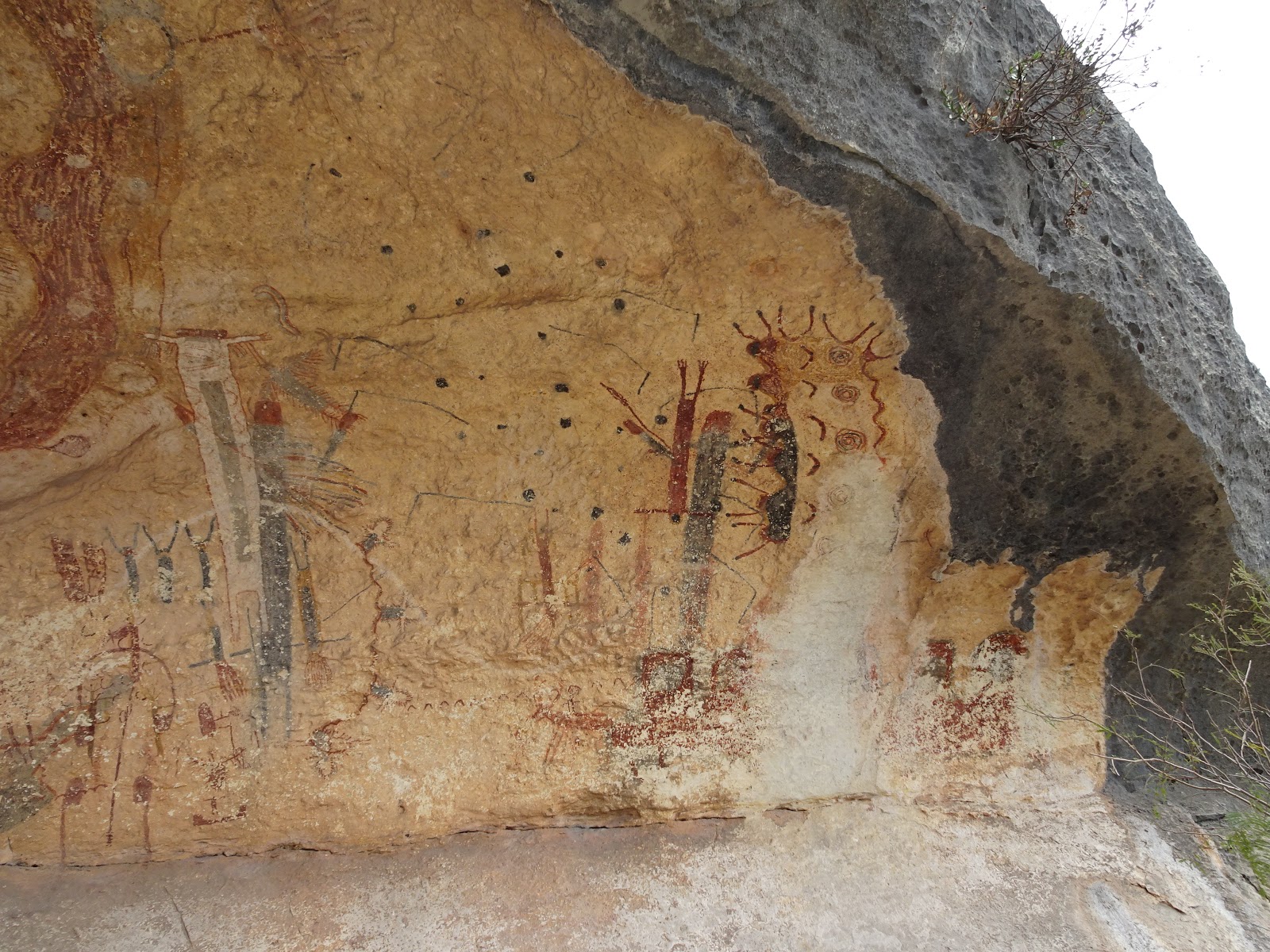
The White Shaman mural is an intricate painting that is 26 feet long and 13 feet high.  It is on the wall of a shallow cave overlooking the Pecos River.


Our guide, Vicky, is an archaeologist with the Shumla Archaeological Research and Education Center.  She is very knowledgeable about the story of the mural as written by Carolyn E. Boyd in her book The White Shaman Mural. In fact, Vicky is mentioned in the acknowledgements of the book.


We stayed at the site for over an hour while Vicky talked about the mural and answered questions. 

The mural tells a story of the birth of the sun and the beginning of time.  It’s possibly the oldest pictorial creation narrative in North America.


The walk back out was steep but wasn’t as difficult as thought it would be.


Looking back the way we came, it was a long way down!


The White Shaman tours are paid, guided tours ($15 per person).  They are given about once a week and sell out quickly.

Friday, March 1, 2019

Seminole Canyon State Park & Historic Site

A few weeks ago some friends asked if we wanted to meet them at Seminole Canyon State Park.  We have never been to this park and were looking forward to seeing it. 


We arrived mid-day and were given Site #1.  It’s a nice site on the end where we have great long-distance views.


The next morning we were scheduled to take a tour here at the park but during the night we had light rain/sleet/hail so the first tour was cancelled.  We headed into Del Rio for lunch (Mi Tierra Linda) and made it back to the park in time for the 3:00 p.m. tour of the Fate Bell’s Pictograph Shelter/Canyon Guided Walking Tour.

We got to the visitor center a few minutes early to pay and to look at the exhibits.


We had about 25 people on our tour.  Our guide was Tanya.  She mentioned that she had been giving this tour for 10 years. She seemed a little burned out.


Our first stop on the trail was The Maker of Peace sculpture finished in 1994 by Bill Worrell.  It’s 17’ 3”.


We had about a half mile to walk to the pictographs.


The shelter was named after Mrs. Fate Bell, who owned the land that the shelter occupies.


These pictographs are considered to be among the finest in the world and constitute possibly the largest collection of pictographs in North America.


The initial excavation in 1932 revealed much material culture, including engraved shells, painted pebbles, fiber sandals, baskets . . .


Eight burials were found. Three of these had no skeletal remains. Presumably they had not been preserved. One was a group burial and contained the skeletons of five individuals.

Fate Bell Shelter is best known for its pictographs, which are among the best documented and best preserved of the Pecos River style. This style dates between three and four thousand years ago.


The central characters of the pictographs are faceless anthropomorphic figures, elaborately dressed and often holding a variety of accessories such as atlatls, darts, and fending sticks.


The views were outstanding.


Looking back the way we had come:


Not much of a fine:


Interesting rocks:


The tour lasted an hour and it was a long way back up to the visitor center:


These pictographs can only been seen with a guided tour through the park.  The costs is $8 each and the tours are given twice a day, Wednesday - Sunday (weather permitting).