Friday, August 23, 2019

Maine Sea Salt Company

After our trip to Wass Island Preserve we drove to Marshfield, Maine where the Maine Sea Salt Company is located.  Their web site said they offer free tours May through October from 8am - 4pm - most days.  I e-mailed ahead as requested just to make sure we could get a tour.

The company was founded in 1998 by Steve and Sharon Cook.

We parked by the side of their house and headed into the store.  Steve soon came out of the house and started our tour.


The sea water comes from Buck’s Harbor, Maine.  It’s brought in 7,000 gallons at a time every few days.  Maine Sea Salt is evaporated in shallow pools in green houses (solar houses).  The green houses are solar stills, evaporating the sea water using the sun for the heat source.


The sea water is pumped into the first set of solar houses to allow anything in the water to settle out and to reduce the sea water to 50% salinity.

This is not salt!  
This is debris and other things contained in the sea water.


The pools are kept shallow, too deep a pool will not heat quickly enough in a day's cycle. The amount of sun and its position in the sky determine how quickly the water evaporates. Just like farming, the weather is very important.

The water is filtered and reduced to 70% in another set of green houses.

House #2

The water is finally pumped to the finishing house for making salt. Here the pool completely evaporates leaving behind the sea salt.

Snow shovels for scooping up salt.

This is sea salt!

The salt is placed in bins to further drain.


The salt is than taken to the production area where it is ground. The salt when ground releases more moisture from the crystals.

Cuisinart’s used to grind the salt crystals into various sizes.

They layer the damp salt between linen towels to remove any remaining moisture. The salt is never artificially heated in a kiln, nor is it washed. Maine Sea Salt is then sifted, to separate various crystal sizes for packaging.


Smoked salt is smoked with a real wood fire in small batches.

Different types of woods for smoking salt.

Steve showing Mark the smoking process.


Very small batches are smoked at a time.  It usually takes about 10 hours for a batch.

Salt production is seasonal, during the summer months.  Maine Sea Salt is sold throughout the United States, in Health food stores, Specialty food shops, and high end restaurants. 


Steve told us that the company has prospered and they have just purchased another 20 acres of land and have started building more solar houses.

Steve was very nice and we enjoyed the tour.  Of course, purchases were made!


Monday, August 19, 2019

The Great Wass Island Preserve

With a cloudy day ahead of us and nothing to do, we both got on the internet to find a day trip.

Mark found a great hike and I found a tour so we set off.

The Great Wass Island Preserve was acquired by The Nature Conservancy in 1978.

There is a 4.5-mile hiking trail but we only walked about 1 1/2 miles.

Map of the trail.

The trail was very rocky with lots of exposed tree roots.


The bogs (or heaths) of Great Wass are unique to this part of the state. They are maritime slope bogs that formed on top of coastal bedrock.


Exposed granite bedrock is evidence of the “Fundian Fault,” a long crack in the Earth’s crust that extends from the Bay of Fundy to the coast of New Hampshire.


Raised bogs formed thousands of years ago as sphagnum moss accumulated in the scoured basins left by retreating glaciers.


The acidic, peat soil supports plants and shrubs that can stand the extreme nutrient-poor environment.


A little world on a large rock.

We found a few flowers and interesting mushrooms along the trail.


The island projects farther out to sea than any other land mass in eastern Maine.

The waters of the Gulf of Maine and the Bay of Fundy meet here and mix to produce a cool, humid oceanic climate.


Even with a little bit of rain it’s a very enjoyable hike.


Next time: The Maine Sea Salt Company


Friday, August 16, 2019

Off To The Race(way)s! - Deja Vue

You might remember last year we resurfaced one of the raceways inside the hatchery (See Off To the Race(way)s! blog of September 27, 2018).

We started on that raceway very late in the season.  The staff was happy with the results and wanted us to resurface the other raceways but there wasn’t time before we left on October 1st.

This year we were asked to resurface 3 raceways and the supplies were ordered.

Supplies ready.  Starting to vacuum.

The first raceway to resurface is next to the one we finished last year.  The staff power-washed the surfaces but we still had to brush down the walls and vacuum all the grit.

We use a skim coat material, which is a special mortar mix for thin, smooth repairs. It is a quick-setting, time-sensitive material.

Left side completed.

The next step was application of the primer coat of the paint system. This was an odd material with the consistency of skim milk.  The top coat was a much thicker rubber material. The coating manufacturer required three coats of the top coat over the primer.  The top coat is a special, fish-safe coating.

Newly finished raceway on the left, last year's raceway on the right.

It looks really good! 

There are two other raceways we need to finish this year.  Last year these raceways contained the future-future brood (which are the three-year old’s this year). 

The large fan is used to dry out the raceway before we vacuum and brush and the skim coat can be applied.


This job is very strenuous and not a lot of fun but the staff really appreciates our hard work.

Wednesday, August 14, 2019

Fort Knox

After visiting the bridge and observatory we headed down the road a little ways to Fort Knox.

View of Fort Knox from inside the Penobscot Narrows Bridge Observatory.

You can buy a combination ticket for the observatory and the Fort ($8 for non-resident.  We weren’t old enough for the senior discount).

Built between 1844 and 1869, it was the first fort in Maine built entirely of granite.


It is named after Major General Henry Knox, the first U.S. Secretary of War and Commander of Artillery during the American Revolutionary War.

Fort Knox never saw battle, though it was manned during times of war.


During the American Civil War volunteers from Maine, mostly recruits in training before assignment to active duty, manned the fort.


Located on the west bank of the Penobscot River in Prospect, Maine, in an area known as the Penobscot Narrows, Fort Knox is one of the best-preserved military fortifications on the New England seacoast.


In 1923, the federal government declared the fort excess property and put its 125-acre grounds up for sale. The state of Maine bought it for $2,121.  It has been administered as a Maine state historic site since 1943.


The fort is one of the best-preserved and most accessible forts in the United States. All of the fort is open to the public.


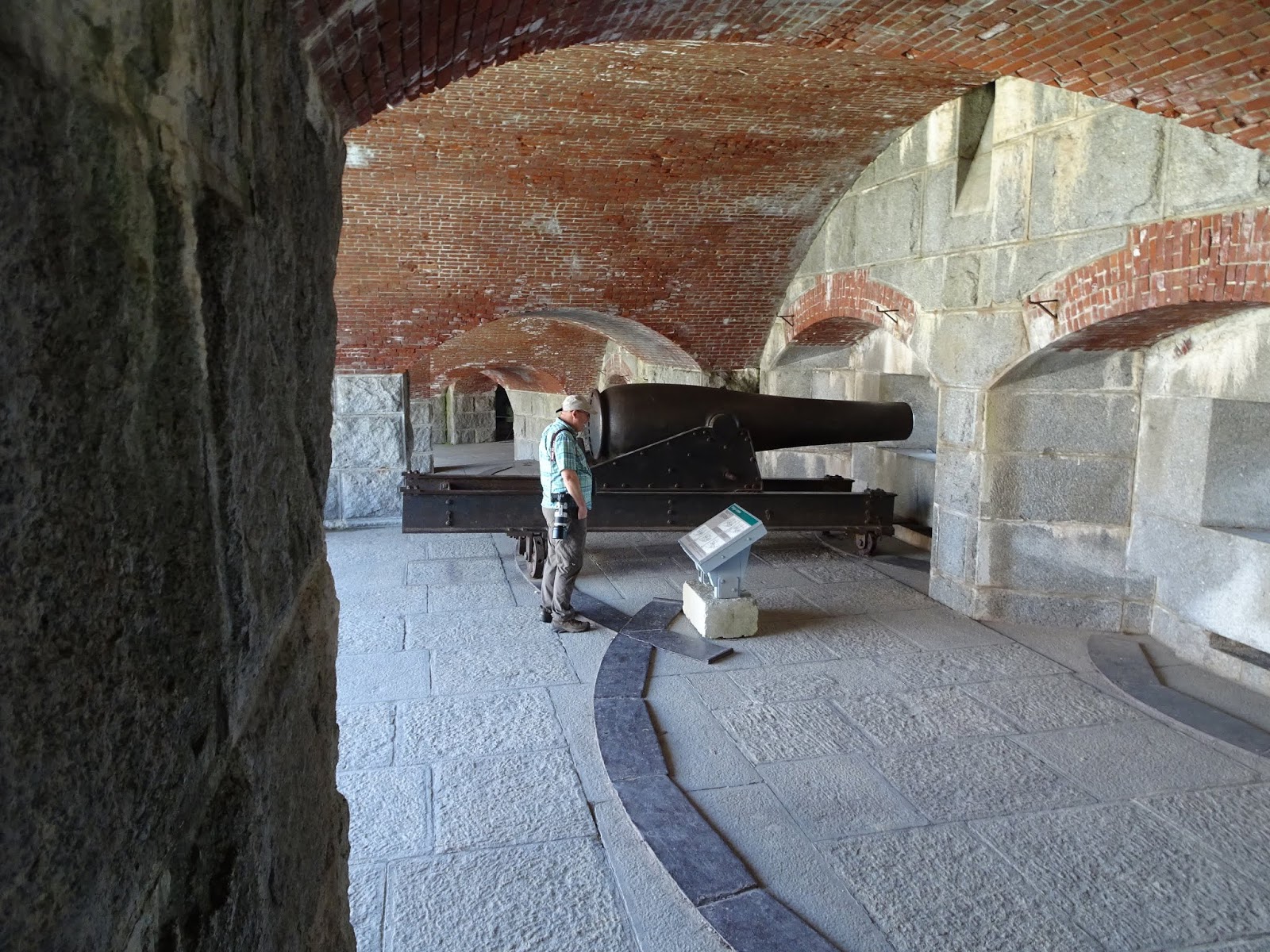
Several period weapons are on site, including two 15-inch Rodman Smoothbores and a 10-inch Rodman Smoothbore.


 A 10-inch Rodman smoothbore

The hot shot furnace was built in 1858 to heat cannonballs for the 32-pounder cannons originally planned for but never installed.  These cannons would have fired heated cannonballs at enemy ships in order to set the ships on fire.

Hot shot furnace.

Keeping gunpowder dry and safe from flame was critical to the safety and function of the fort.  Wooden walls with hidden nails helped prevent sparks, while massive brick and granite walls protected the powder from enemy shells.


The term “battery” refers to the place outside the main fort walls where cannons are located.  Usually cannons in a battery are “en barbette,” meaning they are in the open and placed to fire over a low wall.


This was a wonderful trip and worth a stop if you are in the area.

Magnet worthy!


Monday, August 12, 2019

Penobscot Narrows Bridge and Observatory

Last year we visited the Penobscot Narrows Bridge and Observatory but I never got around to blogging it.  This place is worth a visit if you are ever in the area.

(Click on any picture to enlarge it)

The bridge spans the Penobscot River, linking the town of Prospect with Verona.


The bridge and observatory officially opened in May, 2007.

The interior floor is paved from granite from the nearby Mosquito Mountain quarry.


There are very nice interpretive panels at the base of the observatory.


The observatory is at 420 feet in elevation which makes it the highest bridge observatory in the world.  Lucky for us - there is an elevator!


I did not want to have to walk down 25 stories of steps.  It would not be worth a $20 gift certificate for the Fort Knox gift shop!

The 360-degree view from the top is outstanding!


The bridge spans 2,120 feet from the east shore to the west shore.


The bridge is 135 feet above the Penobscot River.


It is one of only four bridge observatories in the world. The other three are in China, Thailand and Slovakia.

 Looking down at the cars on the bridge.


The interpretive panels are very useful to determine what you are seeing in the distance.


It cost $85 million to design and build.  It was planned, funded, designed, permitted and built in 42 months.

 Driving up to the bridge.

 Driving on the bridge.

Next time: Fort Knox