Tuesday, November 16, 2021

We’ve Got Mountains Too!

In the United States, the U.S. Board on Geographic Names once held the position that what defined a mountain as opposed to a hill was 1,000 feet of local relief.  This was abandoned in the early 1970s due to the lack of a board agreement on this definition. 

The Oxford English Dictionary defines a mountain as “a natural elevation of the earth surface rising more or less abruptly from the surrounding level and attaining an altitude which, relatively to the adjacent elevation, is impressive or notable.”  


The Merriam-Webster dictionary defines a mountain as “an area of land that rises very high above the land around it and that is higher than a hill”.

While there is a conventional understanding that a mountain is higher than a hill, there is no universally accepted definition of a mountain.


We’ve been to the Davis Mountains many times and we were ready to go back.  So, a couple of weeks ago we hooked up the trailer and headed out.  It’s about a 6 hour drive from our house, if we take it easy.  

The Davis Mountains is the largest mountain range in Texas.  It’s part of the southern Rocky Mountains and is surrounded by the Chihuahuan desert (the 2nd largest desert in North America).

The highest elevation in the Davis Mountains is 8,378-foot Mount Livermore (aka Old Baldy), the fifth-highest peak in the state.

It’s a beautiful area with gorgeous sunrises.

We always make a trip out to Balmorhea Lake. The primary purpose of the lake is storage of irrigation water, and it is owned by the local water district. It is also stocked with fish and used for recreation ($5 per car if you are birding, $5 per person if you are fishing).


It is the largest body of water in this area of Texas, and the birding here can be surprisingly good.

There are two types of Grebes commonly found on the lake, Clark's Grebe and Western Grebe. The Clark's Grebe has a black cap that stays above the eye, and a yellow bill. The Western Grebe has a cap that extends slightly below the eye, and has a yellowish-green bill. Confused??

Clark's Grebe

Western Grebe

We enjoyed watching a Western Grebe harassing a Clark's Grebe that had caught a very small fish. The Clark's Grebe was not in the mood to share!

Whatcha' got there??

Can I have it?

We also saw a group of Scaled Quail chicks running through the grass, their mother not far behind!

Scaled Quail chicks

Scaled Quail

There are a couple of wildlife-watching blinds in the state park, and we visited them each evening to see what was using the feeders and the water feature. 

Red-naped Sapsucker

Woodhouse's Scrub-Jay

Another place we like to visit is the Chihuahuan Desert Nature Center. 


They have some very nice displays on the grounds and in the visitor center. 

A new bird blind has been built since we were here last (Feb. 2020).  


Chipping Sparrow

Rock Wren

White-crowned Sparrow

There is a extensive trail system.  In years past, we have hiked all the trails. 

We picked a trail for a little hiking.  The trail started out nice and flat.  It didn’t stay that way for long.  It quickly turned into a rocky, steep incline.  

There are some pretty amazing views from the top and a nice interpretive area. 


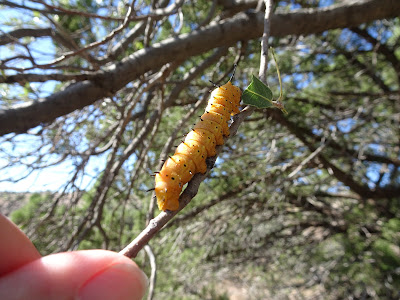
On the way down we ran into these amazing eating machines. 

Osler's Oakworm Moth catapillar - youngesters

Osler's Oakworm - after eating a few hundred leaves.

One day we drove "The Big Loop" which is a 75 mile route that circles the tallest mountain in the area and passes through some beautiful country.  


These mountains are unique in West Texas.  They receive up to eighteen inches of rain a year, while the rest of the Trans-Pecos generally receives only eight to twelve inches annually.

There is virtually no traffic on the route, which makes it very easy to bird along the road. 

Birding from (on) the road

During this stop we were able to watch and photograph a Phainopepla. They are the only member of the Silky-flycatcher family found within the United States. The rest of the family lives in Central America. 

Phainopepla

I forgot to get a picture of our site when we arrived.  So, while Mark was setting the GPS and all the other gadgets before we left, I hopped out and got a picture. 
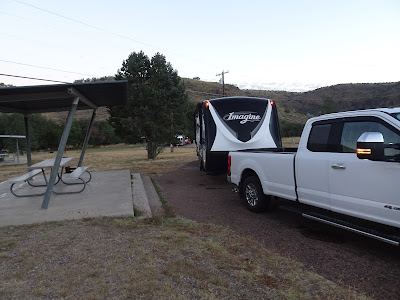
Davis Mountains State Park
Site # 19

I did buy one souvenir.  It’s not a magnet but I’m going to glue a magnet on the back and slap it on the refrigerator.  We stopped at Balmorhea State Park after visiting Balmorhea Lake.

While we were camping in the park we met a nice couple who were interested in birds, and especially in photography. We spent some time with them, and they got us interested in trying to get pictures of the rising full moon. Here is one that came out well.

Full moon rising over the Davis Mountains

Stay tuned. We’re on to our next adventure.


Saturday, November 6, 2021

Going Home - Ecuador – Part 13

Thursday 9/23/21 (Teri)

We were up by 6:00 and walked outside our hotel room to do a little birding.  The hotel staff was setting up numerous tables in the grass area.  Since we weren’t going to see any birds with all the commotion, we went back to our room until 9:00 then headed down to breakfast (scrambled eggs, empanada, fruit, rolls).

Our driver arrived at 10:45 to pick us up for the airport.  She was very nice, spoke only a little English and was happy to have a conversation in Spanish with Mark.  His Spanish is really coming along!

So, about our flight from Quito to Miami.  I’m not sure I can adequately explain my thoughts on the flight. 

But, here goes – the plane was awesome! I spent the first 30 minutes pushing every button I could find.  I did not want to get off that plane – ever!

We got on the plane and the flight attendant told Mark to turn left.  She told me to keep going straight then turn left.  I said “We have seats together!”.  She assured me we would be sitting together. 

My pod:

We had a wall between us:

We put the wall down and took a selfie:


We each had a personal headset to watch movies or listen to music:


The seats moved forward so you could use the foot rest.  They also laid all the way flat for sleeping.


It was very quiet in first class: 


There were thousands of songs to listen to, hundreds of movies to choose from or you could just watch the flight info on your personal tv.

Mark and I have talked about taking longer flights to different parts of the world.  I was always hesitant to be on a plane for more than about 5 hours.  Even in first class it can be uncomfortable.  But, if I was guaranteed a plane like this, I would fly anywhere in the world.  Our flight was 4 hours and it went by way too fast!  There were a lot of good movies to choose from.

Now the bet.  We always have some kind of bet involving first birds seen.  This trip the bet was that each of us named a bird and whose ever bird was seen first at the hotel, won the bet.

Mark went first and he chose a Great Thrush.  I totally cheated and chose a Tanager.  Why was this cheating?  There is only one Great Thrush.  There are 66 species of Tanagers in Ecuador.  Guess who won?

Me!  (This time)
Oreo Blizzard

I was pretty disappointed that there weren’t many opportunities to buy souvenirs.  I did find a pretty magnet at the airport. 

Colibri - "Hummingbird" in Spanish

I had Mark print out this picture and I attached it to a magnet sheet.  It turned out great and looks good on the refrigerator.

Final Thoughts:  This was a great trip.  Our guide, José, was wonderful.  He was very knowledgeable, funny and enjoyable to be around.

It was interesting staying at one lodge for the whole trip.  It was nice to just have to unpack once.  It had its limitations though.  Instead of driving farther distances each day, we covered the same areas several times. The trip could have been a couple of days shorter without making any difference in birds seen. 

Other than the soups, I didn’t really care for much of the food at the lodge.  In my opinion it would be much better if they served more traditional Ecuadorian food.

The Lodge was nice and clean but wasn’t as elegant as advertised.  It was certainly fine for us, just not what we expected.  If there had been a lot of other guests at the same time, I think it might be pretty loud with the rooms right off the community/kitchen/living area. 

I think we will probably try Tropical Birding again.  We have a destination in mind and they have a trip scheduled. 

Birds seen this trip: 331

Life birds: 32

Final Thoughts (Mark): We had planned this trip not only to return to a wonderful part of the world and bird, but also to give this agency, Tropical Birding, a try. Overall the trip went very well. Staying in one lodge for this extended length of time was nice from the standpoint of not having to pack up and move every couple of days. But it also limited the variety of habitats, and therefore birds that we were able to access. I don't know that I'd do it again. 

I think that the key to a trip like this is the guide, and José was outstanding. I'd give him an A+.  Just a great person to spend time with, and certainly talented and knowledgeable about the birds. 

Tandayapa Lodge has an outstanding set of bird feeders and I really enjoyed the photo opportunities.  Overall the lodge was fine, but given everything we'd heard about it prior to the trip I expected it to be just a bit nicer. 

The food was probably the biggest surprise of the trip for me. We'd heard plenty about the amazing, gourmet food served here, but it was below-average compared to most other places that we've stayed. 

I came away thinking that Tropical Birding did a fine job with the trip, but in terms of logistics, lodging and food they really weren't that different than other agencies we have used in the past. They do offer some amazing trips, so perhaps we'll try them again. 

This concludes our 2021 Ecuador trip.

If you enjoy the blog please click the “follower” button.


Thursday, November 4, 2021

Quito, Ecuador – Our last day – Part 12

Wednesday 9/22/21 (Teri)

We headed to the upper black-light sheet before breakfast this morning.  This time there were insects on the sheet and we saw some good birds.

We headed out about 7:30 to the Upper Tandayapa valley.  I think this was the 3rd time we have been in this area during this trip.


We were back at the lodge by noon where we finished packing.  Our last lunch was vegetable soup followed by fried shrimp and french fries.  We went over the bird list for the morning and left the lodge for the last time at 1:00 pm.

We stopped at a couple of places to bird before getting to our hotel.  We stayed at the same hotel and even had the same room as our first night. 

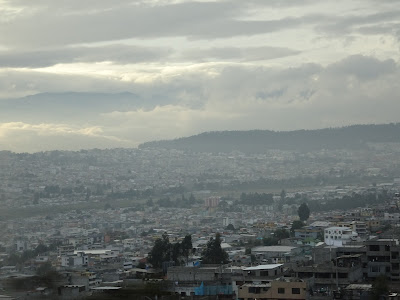
Quito is the capital of Ecuador.  Ecuador in Spanish means equator.  The locals call the equator "la mitad del mundo" – the middle of the world.

The population is a little over 2 million and it’s the 2nd highest official capital city in the world.


We got to the hotel a little after 4:00.  José came into the lounge with us and we went over our bird list for the afternoon birding.  He also wanted each of us to name our 3 favorite birds on the trip.  It was hard to just pick 3!

Tracy (the other lady on the trip) was going to be flying out at 11:00 pm so Tropical Birding had booked her a day room at the hotel.  After going over the bird list, she went on to her room to get some rest before her over-night flight back to New York. We didn’t see her again.

We had a light dinner, potato soup (Teri), salad (Mark) and headed to our room for the evening.  The hotel was once again loud with two groups singing and playing music.  Luckily we could not hear any of the noise from our room.

Wednesday, 9/22/2021 (Mark)

Last day at the lodge! We got up at 5:15 and walked up to the blacklight blind, hoping to see some birds eating insects off of the white fabric. We’d come up here several mornings ago, but apparently arrived too late and didn’t see much. This time we got there while it was still pretty dark, and ended up getting really good looks at a female Zeledon’s Antbird. It was very dark but I managed to get decent images with the camera. Pretty amazing bit of technology. 


Zeledon's Antbird

One the way back to the lodge we got to see Strong-billed Woodcreeper, another new bird for the trip.

Strong-billed Woodcreeper

After breakfast we headed up into the Upper Tandayapa Valley one more time to see if we could find any more new birds. It was slow at first, but we managed to find a couple of mixed feeding flocks and saw Grass-green Tanager and Rufous-chested Tanager. Neither were particularly cooperative for pictures, but I got identifiable images. 

Grass-green Tanager

Rufous-chested Tanager

We returned to the lodge for lunch at noon, then loaded up the van for the trip back to Quito.

We stopped at a dry scrub forest (Calacalli) on the way to Quito to look for some species that prefer that habitat. We saw several Golden Grosbeaks, Tufted Tit-Tyrants, and best of all, an amazing Black-tailed Trainbearer. This hummingbird has a remarkably long tail and was a real treat to see flying.

Golden Grosbeak

Tufted Tit-Tyrant

Black-tailed Trainbearer

Our last birding spot was the Quito Airport Ponds. We stopped on the shoulder of the toll road next to the airport, crossed to the raised median, and then looked through the fence down at the large pond. Certainly an odd and unnatural way to bird! We did pick up a few water species like Slate-colored Coot, Andean Gull, and Andean Teal. Sort of padded the bird list with some new species at our last stop.

Andean Gull

Slate-colored Coot

We arrived at our hotel at 4:15, sat with José for a bit doing our last bird list of the trip, and then said our goodbyes. Once again, our “small, quiet hotel” was hosting a couple of large groups for graduation, and there was loud music, dancing, etc. We had a light dinner at 5:30, then retired to the room for the night.

Next time: I didn’t want to get off the plane, who won “the bet” (I totally cheated!), final thoughts on the trip, and my souvenir.