Sunday, May 10, 2020

Trinidad/Tobago - Day 4 - Devilbird and the Beautiful Scarlet Ibis

2/28/2004 (Saturday)

A special attraction on the Asa Wright property is a breeding colony of the nocturnal Oilbird, or Guacharo (Steatornis caripensis). Located in Dunston Cave, a beautiful riparian grotto, it is the most easily accessible colony known for this species.

Only guests staying at Asa Wright are allowed to go down to the cave. 

Oilbirds are nocturnal feeders on the fruits of the oil palm and tropical laurels. They are the only nocturnal flying fruit-eating birds in the world. They forage at night, with specially adapted eyesight.

We went on the Oilbird Cave walk at 8:30 with Molly. On the way down we got great looks at a Collared Trogan, and fleeting looks at a Plain Antvireo. A Black-faced Antthrush called almost the whole way down, but never revealed itself. 


The trail down to the Oilbird cave was quite steep and slick in some spots as it descended into a wet grotto and streambed. 

At the bottom we were taken two-at-a-time into the cave to view the Oilbirds. 


First we got looks at about ten birds perched on various ledges thirty feet away, and then at a group of six just eight feet overhead. 

The Oilbirds are surprisingly large, with blood red eyes and they make a terrible screaming/choking call; all of which has earned them the nickname of “Devilbird”. 

Oilbirds
  
Venezuela’s indigenous people had long been well acquainted with the birds, and in particular the plump baby guácharo, which are rich with precious fat that could be used for everything from flavoring food to fueling torches. 

Each year, during what they called the oil-harvest, they hiked into the cave and used poles to destroy the nests, killing baby guácharo by the thousands, and then rendered their fat into earthen pots.

Fortunately for the guácharo the people believed the souls of their ancestors dwelled in the deepest recesses of the cave, and refused to disturb them, which meant that only the birds closer to the mouth of the cave met the unfortunate fate of becoming torch fuel. 

Teri and I stayed out hiking until 11:30, but didn’t find anything new.  We showered, ate lunch, and then left for our Caroni Marsh trip at 1:30. Traveling through town once again made us thankful to have a driver. We wouldn’t try to drive it ourselves on a bet. We stopped near the marsh at a canal and saw Pied Water-Tyrant and White-headed Marsh-Tyrant, as well as Wattled Jacana and Yellow-hooded Blackbird. At the marsh visitor center we saw several Scarlet Ibis feeding, and found them to be an unbelievable shade of crimson. Our guide called in both a Rufous-browed Peppershrike and a Black-crested Antshrike. We also had an unidentified flycatcher pop up that confused everyone.
  
Caroni Marsh Visitor Center 

We boarded a wide wooden boat with several full-width bench seats, and headed down a canal to the marsh. 


We saw numerous Little Blue Heron along the way, as well as crabs and a small school of four-eyed fish. 

The little "bubbles" in the water are four-eyed fish. 

The four-eyed fish have eyes raised above the top of the head and divided in two different parts, so that they can see below and above the water surface at the same time.

At one point the boatman stopped and pished up a group of Bi-colored Conebills. The males are much bluer than shown in the T&T field guide plates. This was no real surprise as the plates in the book were proving to be pretty bad. Farther down we stopped under a tree that had a “tree boa” curled up on a branch. 

Tree Boa

Finally, we anchored the boat opposite one of the roost islands used by the Scarlet Ibis and other egrets and herons. The tide was low, so we were told that the ibis would be feeding later into the evening than normal. Shortly before dark the Scarlet Ibis began flying into the roost island in groups ranging from four to thirty or more. As each group landed the trees of the island began to look like Christmas trees decorated with bright red ornaments. 


After several hundred ibis had landed, we headed back to the launching area, and drove back to Asa Wright, arriving around 7:00.

Our boat ride back at dusk.

We ate dinner, and then watched a slide show on the various fauna of Asa Wright, including bats, other mammals, reptiles, and birds. We then started packing our bags, showered and went to bed.

Next time: Day 5 - The second half of our trip - Tobago.

Saturday, May 9, 2020

Trinidad/Tobago - Day 3 Clicking and Snapping

2/27/2004 (Friday)

At 6:15 a.m. we walked down the Discovery Trail to the White-bearded Manakin lek and found it literally hopping with the little guys.

Thirty or more males were displaying, with their peculiar snapping wing sounds and vigorous hopping back-and-forth between twigs near the ground. When a female would happen along, the displays got even more frantic. It was like watching popcorn pop.

Teri and I videoed the displays, but the dim light kept them from coming out as well as we’d hoped. 


Turn your sound up!

 After breakfast we went on another orientation walk, this time with Mukesh. He said that he would show us a Golden-headed Manakin display area that we’d been having trouble locating. After covering the same ground that we had with Molly the previous morning, we went down an un-named trail linking Discovery and Bellbird Trails at about the halfway point.

Nutmeg Tree

We saw several Golden-headed Manakin males about 25 feet up in the trees. Their display is less remarkable than the White-bearded species, and consists of flying back-and-forth rapidly in the trees. The males are a spectacular jet black, with bright golden yellow heads, making them easy to see against the green canopy despite their small size. We saw another group farther down the linking trail, then followed Bellbird around to the intersection with Discovery, and back up to the main house. We got back to the room around noon.
  

We were discovering by now that chiggers are a problem in Trinidad! We were surprised since we hadn’t walked through any grass, but apparently the chiggers were on the trails.

We took a short nap after lunch, and then headed back out at 3:30. We followed Chaconia, Heliconia, and Bamboo trails from the main house down to the road below the pool. The trails were less used and more heavily vegetated than the other trails, which made bird spotting more difficult. We did get good looks at a Cocoa Woodcreeper excavating a cocoa pod, and at a White-flanked Antwren.

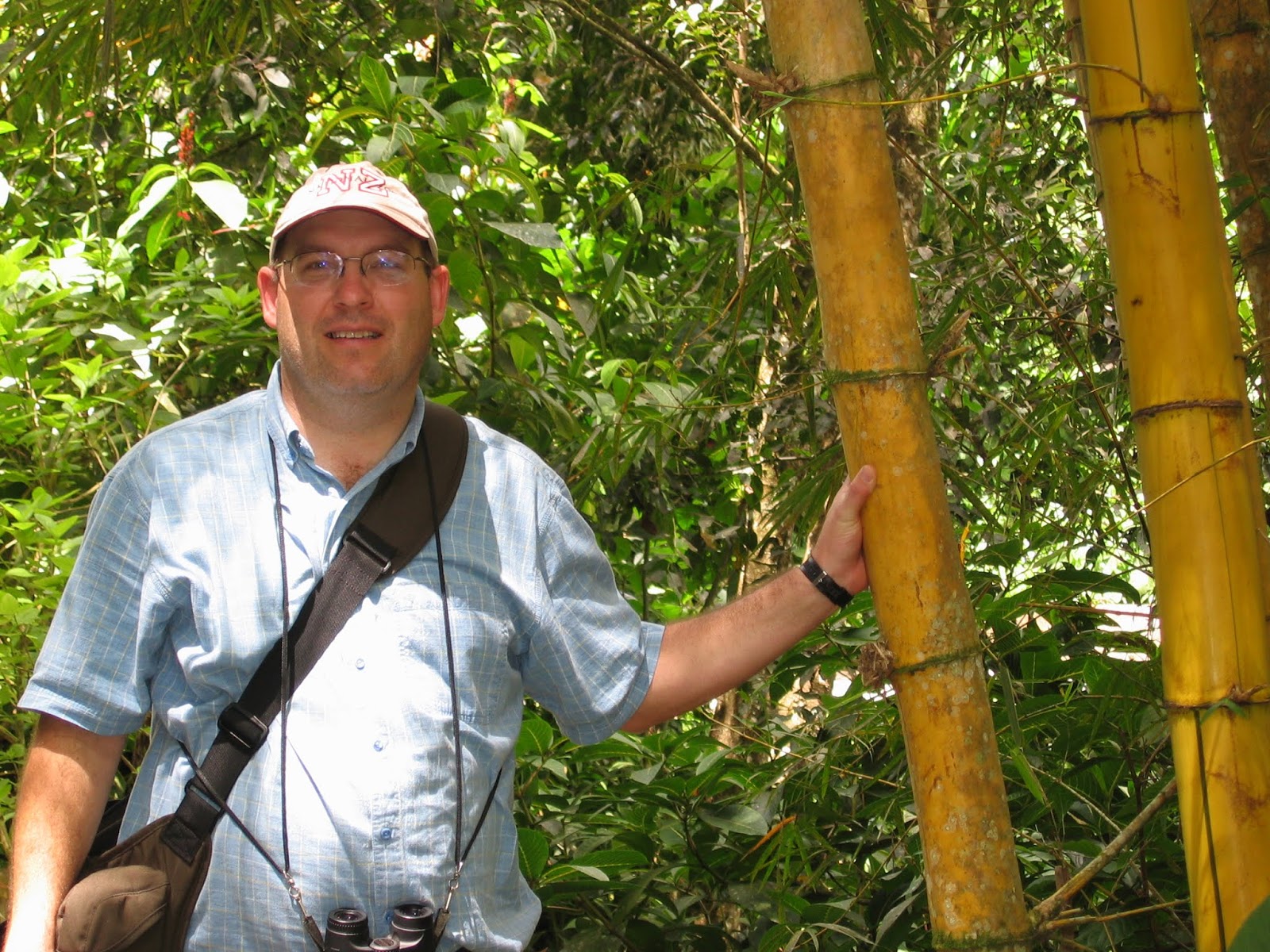
Giant Bamboo

Beautiful trails along water.

Cocoa Pods

We enjoyed our second dinner that evening. We were really pleased with the meals being served at Asa Wright. The food was simple, with salads, plenty of vegetables, and a simple meat dish that wasn’t too heavy. Desserts, when offered, were something simple like fruit or pudding. Breakfasts included dry cereal, fruit, scrambled eggs, bacon, and one morning, pancakes. Drinks at meals were generally grapefruit juice with breakfast, and water or tea with lunch and dinner. Soft drinks, beer and cocktails were available on the veranda in the afternoon.

At 8:00 we watched the second half of the John Acorn video on Asa Wright. Our naps helped us to be more alert this evening, and we even stayed up for a bit and read before turning in.

Next time: Day 4 We go under ground to find the Devilbird.

Friday, May 8, 2020

Trinidad/Tobago - Day 2

2/26/2004 (Thursday) 

We both had restless nights, thanks in part to the hooting Ferruginous Pygmy-Owl outside of our room, but did get some sleep. 

Mark outside the Cocoa Suite.

We awoke at 5:30 a.m. and were on the famous Asa Wright veranda at 6:00.

The world famous Asa Wright veranda.

We immediately began seeing the amazing birds that we’d spent so much time studying. First was a Blue-crowned Motmot; then Crested Oropendola, Bananaquit, Green Honeycreeper, Palm Tanager, Grayish Saltator, and White-lined Tanager. As the morning progressed we added Purple and Red-legged Honeycreeper, Blue-gray Tanager, and got looks at a pair of Channel-billed Toucans and a Ferruginous Pygmy-Owl, in spotting scopes. Orange-winged Parrots “blink-blinked” overhead.

Crested Oropendola nest.
Long, slender next are constructed to keep out monkeys.

View from the veranda.

View of forest and feeding table from the veranda.

Asa Wright is listed by Audubon as one of the top ten eco resorts in the world.  It comprises nearly 2,000 acres of mainly forested land in the Arima and Aripo Valleys of the Northern Range and located at 1,200 feet in the mountains of the Northern Range.

The Centre’s main facilities are located on a former cocoa-coffee-citrus plantation.


We had just bought digital cameras before this trip.  We were not sure how many pictures the memory cards would hold and were very careful not to take very many pictures.  

Unfortunately, most of our bird pictures are just little specks so there will not be a lot of pictures of the beautiful birds.

Chestnut Woodpecker

Green Honeycreeper

Crested Oropendola on a feeding table.

Agoti under the feeding table.

We called this guy "Stubby".


The breakfast bell rang at 7:00 a.m., and we ate breakfast with some of the guests and naturalists. At 8:30 we went on our orientation walk with Molly, one of many naturalists employed by the Nature Centre. She took us down the Discovery Trail, and pointed out numerous plants, flowers, termite nests, leaf-cutter and army ants, and several birds. Most interesting were two Common Potoos, which were roosting in trees. They looked exactly like branch stubs, and would have been impossible to find unaided. We heard a Bearded Bellbird clanging away, but did not see it.

Mark and Molly.

Termite nest high up in a tree


Common Potoo

Molly left us at the intersection of Discovery Trail with Bellbird Trail. We started down Bellbird Trail, but the continuing calls of the bellbird coaxed us back up to the intersection. There we found a Bearded Bellbird perched about fifteen feet up in a tree, calling endlessly. We actually had to move back away to get a decent view of the bird though binoculars. The volume of the calls was really unbelievable. 

Both Teri and I took videos with our digital cameras. The image of the Bellbird is tough to make out, but the audio comes through loud and clear! We watched him “clang” for a full twenty minutes.


Click on video for Bearded Bellbird call.
Turn up your volume!

Bearded Bellbird

After lunch we hiked down the Discovery Trail, then back up along the Chaconia Trail. As we neared the main house we saw both Green and Little Hermit feeding in the low flowers along the trail. We then walked down the road to the beautiful natural pool fed by the river, and then back up to the house along the Motmot Trail. 


That evening the naturalist played a John Acorn (Nature Nut) video featuring the birds of Asa Wright. We had a hard time staying awake through it, and headed off to bed for a good nights sleep.

Next time: Day 3 Clicking and Snapping - that's what Manakin's do.

Thursday, May 7, 2020

Trinidad & Tobago, West Indies - Day 1

Our first trip out of the country was to Trinidad/Tobago in 2004 (February 25, 2004 - March 3, 2004).  Way before we had ever heard of blogging, Mark wrote a journal about our trips.  This is that journal.  Additional information has been added, in blue, for the blog.  Enjoy our trip back in time!


2/25/2004 (Wednesday) 

We woke up at 4:15 a.m. so that we could get on the road by 4:45. We arrived at the airport at 5:30, and left for Dallas on time at 7:00. Our connection in Dallas got us to Miami at 12:30 (now EST). Thunderstorms in Miami delayed our departure for Trinidad about an hour. In spite of rumors to the contrary, British West-Indies Airlines was fine, and they actually served an edible meal. We arrived in Trinidad about 9:00 p.m. (now Atlantic Standard Time), passed quickly through Immigration and Customs, and were immediately met by our driver. I tried to get into the drivers seat, which was our first reminder that they drive on the left side in Trinidad!

The Republic of Trinidad and Tobago is the southernmost island country in the Caribbean.  The islands are 81 miles south of Grenada and 7 miles off the coast of northeastern Venezuela.

Trinidad and Tobago were ceded to Britain in 1802 as separate states and unified in 1889.  They obtained independence in 1962, becoming a republic in 1976.

We drove through the city streets of Arimas on the way to the Nature Centre. Carnival had finished the previous night and there were plenty of folks hanging out in the streets. We were glad to have a driver, since the road to Asa Wright Nature Center was narrow and winding, with lots of oncoming traffic returning from a popular north shore beach. The folks were celebrating “Cool Down”, which is the day following Carnival, and many of the drivers were still partying as they came down the mountain.

We got to Asa Wright about 10:15 p.m., and were assigned to the Cocoa Suite. 


We had gotten lucky, as the suite was quite large with nice high ceilings. We later found out that it had been a cocoa drying shed, and part of the shed had been closed-in to form the Cocoa Suite. 

Sandwiches had been left for us in the room. We ate, showered, and went to bed in the two comfortable twin beds. The night was warm and humid, but the room had a decent (if loud) ceiling fan to stir the air and keep us reasonably comfortable.


The area surrounding our suite was beautifully landscaped.


This blue orchid was hanging in the arbor right outside our front door.  
The bird in the orchid is a Banaquit.

There was a large sitting area to the right of our suite.


Next time: Day 2.  Our first look at the famous Asa Wright veranda.

Monday, May 4, 2020

Magnet Withdrawal

We have been home for several months.  This is very unusual for us.  

As we travel, I buy magnets as souvenirs. 

This is the magnet that started my collection.  I bought it over 20 years ago.  I only bought a few magnets before our retirement in 2010.  After retirement my collection grew quickly.  These days I’m more picky about my magnet purchases.  If I don’t like any of the magnets available, I do not make a purchase.

McDonald Observatory in Fort Davis, Texas. My first magnet.

Some magnets are kept in the RV but most of them are left on the refrigerator in our home in Texas.


In our RV I have a couple of metal cookie sheets that I hang on the wall:


I try to get a magnet from every place we volunteer but that isn’t always possible.


I try to find magnets that are unusual or have movement or a 3D effect:

Shakers

Moveable. The claws move and open.

3-D

3-D

A perfect magnet will have the city and/or state somewhere on it.  I will buy a magnet without that information (if it’s really pretty, or cute) but I don’t have very many like that.  Can you guess where this magnet came from?


If the magnet is large enough, I write the date we visited on the back.


Did you guess Aspen, Colorado for the gold aspen leaf?

Not all magnets started out as magnets.  Sometimes I make my own.

Louisville Slugger Museum and Factory Tour.

Tabasco factory tour. 

Factory tours are a lot of fun and are magnet worthy:


The license plate magnet is a great idea.  This is the only one I have but I will start looking for them on future trips.


Sometimes we visit several attractions in a state and I end up with many magnets.

Florida

We have been to Canada many times.  It’s my favorite birthday destination.


We have been to Central and South America numerous times.  Here are a few magnets I’ve purchased.

Ecuador, Panama, Costa Rica, Trinidad &Tobago, Belize

Unfortunately, some of the places we visit don’t offer magnets at all and that is disappointing.

Every trip, tourist attraction, or point of interest we visit, I always ask myself “was it magnet worthy?”

I hope we get back on the road soon.  I really need a new magnet.