Monday, May 18, 2020

What Can You Do In 60 Years?

You can . . .

Go to school:
  
Graduate from college:


Get married:

Have a successful, award winning, career:


Visit almost every state in the US:

Arizona

California

Colorado


Alaska

Vermont

Utah

Missouri

Arkansas

Pennsylvania

Hawaii

Kauai (Also Hawaii)

Oregon

S. Padre Island, Texas

You can pursue many hobbies and interest:

Hiking. Ruidoso, New Mexico 

Biking. Leadville, Colorado

Disc Golf

Model Planes

Photography

You can volunteer over 7,500 hours (after retirement).

Alamosa NWR, Colorado

Small animal trapping. Monte Vista NWR, Colorado

Building butterfly houses.  Key Deer NWR, Florida

Green Crab Trapping.  Dungeness NWR, Washington

Building Bluebird houses.  Green Lake NFH, Maine

Sauer-Beckmann Living History Farm.  LBJ State Park, Texas

Ocelot trapping.  Laguna NWR, Texas

Jr. Ranger Programs.  Farragut State Park, Idaho

Educational Programs. Santa Ana NWR, Texas

Wild Wednesday Walks, Key Deer NWR, Florida

You can visit other countries:

Asa Wright Nature Preserve. Trinidad, West Indies

San Pedro, Beliz

Canada, New Brunswick, Nova Scotia, Prince Edward Island

Ecuador

Tobago, West Indies

Costa Rica (4 trips)

Panama (2 trips)

You can do a lot in 60 years.

Feliz CumpleaƱos, Mark


Wednesday, May 13, 2020

Trinidad/Tobago - Days 7 & 8, Final Thoughts

3/2/2004 (Tuesday) 

We got up once again and hiked up the road behind the hotel. This time we got great looks at two different Rufous-tailed Jacamars, and also saw a Scrub Greenlet. The weather was looking a bit more threatening, so we returned to the hotel and took it easy most of the rest of the day. We did go out snorkeling one more time, and had the best dive of the trip by going out farther than we previously had. The water was clearer with more fish, and we avoided most of the jellyfish. It rained on and off through the day, so we relaxed and read, and got packed up in the evening for our early morning departure. 


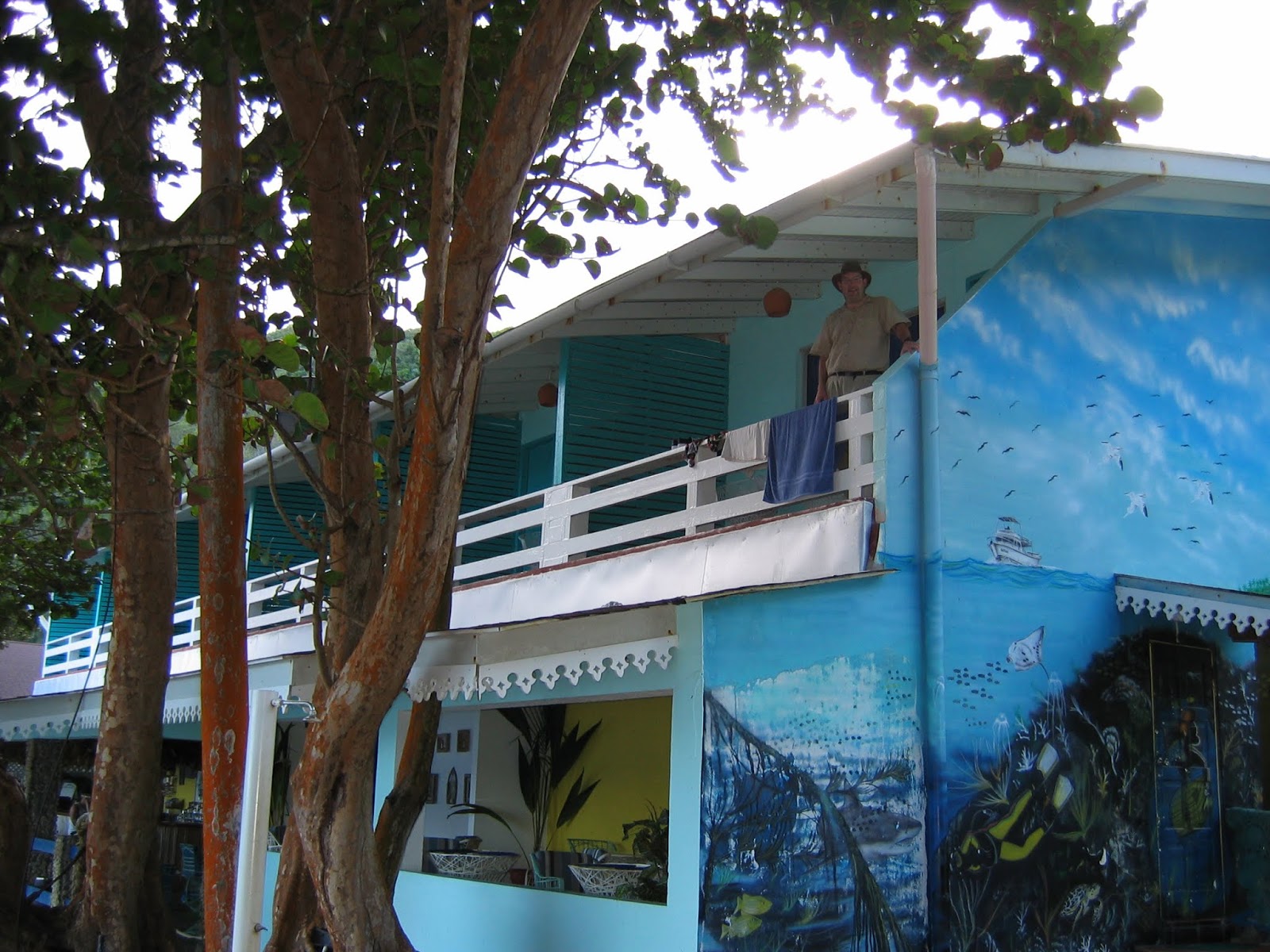
Mark on our balcony.


3/3/2004 (Wednesday) 

We woke up at 3:15 a.m., met our driver at 3:50, and were dropped off at the Tobago airport at 5:00. We sat out in a covered outdoor area waiting for the outdoor ticket counters to open. People slowly accumulated until the ticket agents opened up about 6:00. We got on our 6:40 flight and landed in Trinidad where we had about a two-hour layover. We then left for Miami at 9:05 and landed around noon. We cleared Immigration, picked up our bags and cleared Customs, then re-checked our bags onto American Airlines and settled down for a three-hour layover. We were finally in the air again at 3:30, landing in Dallas at 6:00. Our final leg got us to Austin at 8:00, and we arrived back at the house at 9:00. It had been a long day, but frankly not as bad as we’d feared.


Final thoughts:

We’d enjoyed our time in Trinidad at Asa Wright more than we did our time in Tobago at Blue Waters Inn. Trinidad seemed more of a birding destination, while Tobago was more of a luxury resort type island. In retrospect we could have booked a one-day bird trip for Tobago that would have taken us into the forest, and broken up the monotony of our second day. Another option for Tobago would be to find lodging that places more emphasis on birding and less on diving. Ellen and Cara were moving to some cottages on Man-o-War Bay that sounded better suited for ecotourism. Other cottages were also mentioned.

We think that a next trip could be limited to Trinidad, staying at Asa Wright for an entire week. We would plan to take several birding trips off of the Centre grounds. Trips booked by “Independent Travelers” included just the guide and individuals booking the trip. We spoke with several couples that had arranged such trips and they seemed pleased with the results. This would avoid the problem of booking a group tour, where the entire group goes out on a couple of buses on each trip. These larger group trips did not look like our cup of tea.

We didn’t need our suggested “light jackets”, as it simply never even got cool. A single long-sleeved cotton shirt was plenty, and even that was more for sun protection then warmth. Other than chiggers, insects were not a problem, but a larger can of aerosol insect repellent would make it easier to hose down socks and pant legs. I could have used two more short sleeved shirts, as I’d worn one and brought only two additional. A couple of times I had two out to wash, and was stuck in the single remaining shirt. Likewise briefs. Asa Wright offered very reasonable laundry service, and they washed, ironed and returned clothes the same day.

Since we were there at the dry season, we didn’t have a problem with wet footwear. We’d both gone to considerable efforts to bring extra footwear that could be soaked. This was supposed to be for the walk down to the Oilbird cave. However, that walk was treacherous enough that we needed our boots, and we didn’t end up stepping in water anyway! We were informed that during the wet season there was no choice but to walk in the water, and that some people simply went barefoot for that portion of the walk.

We didn’t really need raingear, and we’re not sure that rain jackets would be a good solution anyway. What showers there were, were pretty intense and quick, and we would have spent more time fussing with putting on and re-packing wet raingear than wearing it. A small, collapsible umbrella as suggested in a couple of references might be the best compromise. Or, simply getting rained on was not bad, as it was pretty humid anyway. The only real issue was keeping optics and cameras dry.

Hope you have enjoyed our first trip out of the country.  We have learned a lot since 2004.  A lot more about digital cameras and a lot more about traveling and birding in a foreign country. 


Tuesday, May 12, 2020

Trinidad/Tobago - Day 6

3/1/2004 (Monday) 

Around 6:30 a.m., we headed back up the dirt road. The Chachalacas were making terrific noise, as were a group of Orange-winged Parrots. We got more good looks at the antwrens and antshrikes, as well as both grassquits. I got a good but fast look at a Rufous-tailed Jacamar. At first glance it looked like a really big hummingbird, but then the field marks hit me. It moved back into the brush before Teri could get on it. Farther down the road Teri spotted a Ruby-topaz Hummingbird, which was beautiful with a surprisingly red tail. It showered on us twice, but luckily we’d left our new raingear in the hotel room so it didn’t get wet! We actually stayed pretty dry by getting under a tree, and later under a rock overhang. On the way back we saw another Ruby-topaz hummer, and the jacamar made a single flycatching flight.

Rufous-vented Chachalaca

Male Barred Antshrike

We went snorkeling again after breakfast. We swam out farther to a really nice area, but we got into some small jellyfish that were stinging Teri quite a bit, so we got out of there. The Jellyfish weren’t bothering me much, but they left little red spots on Teri, and she said that they felt like bee stings. Teri got out, and I snorkeled around for a bit longer, then we headed back to the room to relax as we were both getting a little run down.

The view from our balcony.

Relaxing on the balcony.

Mark updating the bird list.

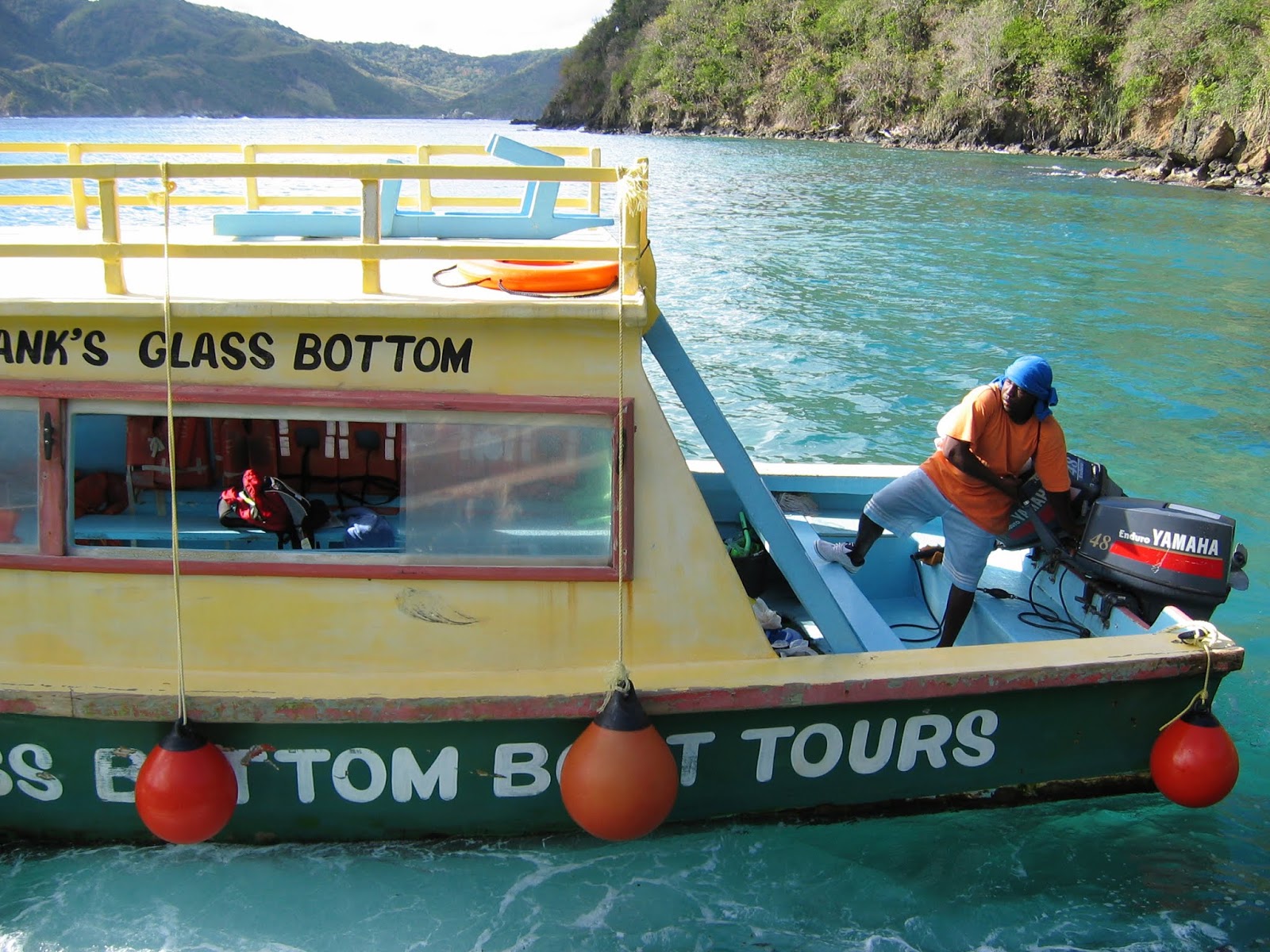
After lunch we went out on “Frank’s Glass Bottom Boat Ride” First we went over some really nice coral reefs while Frank pointed out the various fish species to us. In addition to the many fish we saw the largest Brain Coral in the world. It was around 24’ long, 16’ wide, and 8’ tall. The parrotfish had eaten some pretty large holes in it, but it was certainly impressive.

Waiting on the dock.

Frank's Glass Bottom Boat.


We landed at Little Tobago Island and hiked in on a steep trail. We first went to a small steep-sided bay where Red-billed Tropicbirds, Magnificent Frigatebirds, Brown and Red-footed Boobies were flying. 


Red-billed Tropicbird

The rock in the middle of the pictures has a Brown Booby nest on it.
We saw both Brown Boobies and Red-footed boobies.

Then we went to an area where Red-billed Tropicbirds were nesting on the ground within just a foot or two of the trail. In the same area was a cove where both Booby’s had nests on the opposite side cliff.


Red-billed Tropicbird

We re-boarded the boat and as we pulled away saw a large Iguana climbing a rock right at the edge of the ocean. The boat stopped on the way back to allow about twenty minutes of snorkeling, but we hadn’t known about it so did not have our gear.

Beautiful views.

Red-billed Tropicbirds flying.

Back on the dock.  Time to relax.


Next time: Our last couple of days spent relaxing and final thoughts on the trip.

Monday, May 11, 2020

Trinidad/Tobago - Day 5 - Tobago

2/29/2004 (Sunday) 

We decided not to get sweaty before our flight, so slept in a little later than normal. We got onto the veranda at around 7:00. Of course, our new friends Jeff and Bev (from Great Britain) told us that they’d been seeing a Squirrel Cuckoo that morning. We’d missed that bird so far, and luckily the naturalist was able to relocate it and we got great scope views. It was cinnamon colored with a very long tail, tipped in black and then white. A Barred Antshrike male and female then appeared alongside the veranda in a bush, which filled the gap on another species that we’d missed the first three days. Who knows what we might have seen if we’d simply stayed on the veranda the whole time!

Female Barred Antshirke

Our driver arrived at 9:00 a.m., and dropped us at the Port-of-Spain airport an hour later. The airport was a bit confusing because of flights leaving for Tobago within just a few minutes of each other, but we boarded our flight and arrived in Tobago about 11:30. We were met by our driver and driven to the Blue Waters Inn on the far end of the island by 1:00. The towns of Tobago were much smaller and cleaner than those on Trinidad, which made sense because Tobago is principally a tourist economy.

Checking in at the Blue Waters Inn

View of the Caribbean

The Blue Waters Inn was a more conventional hotel than Asa Wright, and seemed to cater to more of a “Club Med” type of crowd. The rooms were very nice and air-conditioned, and there was a lot of emphasis on drinking and dining. The first birds we saw were Rufous-vented Chachalacas roaming the grounds. We had lunch with Elaine and Cara whom we’d met at Asa Wright, and they said that the snorkeling was excellent.

Our room. Back door leads out to the balcony. 


After lunch we headed over to the dive shop to rent flippers and headed for the beach. The waves were breaking pretty hard. The water was comfortably cool and very clear, with lots of brightly colored fish. 

We saw a parrotfish around eighteen inches long, a pufferfish, and a long skinny fish that was eighteen inches long but no more than one inch high. After taking about ten pictures with our underwater camera I lost it, so that was the end of that! One would think that you could find a bright blue camera in clear water, but you can’t!


The dive shop had a pet Macaw.

After snorkeling we walked up the entrance road to the Inn, and turned on a dirt road that continued up above and behind the hotel. We got great looks at White-fringed Antwren, Barred Antthrush, and Blue-black Grassquit. We got fleeting looks at Black-faced Grassquit as well.


Next time: Boobies and Glass Bottom Boats - it's not what you're thinking!