Saturday, February 5, 2022

Part 2: New Bird, New Magnet, New Mexico

The next morning we took our time leaving the hotel.  With a temperature of 25 degrees there wasn’t any hurry. 

We arrived at the Rio Grande Nature Center State Park when they opened at 8:00 am. 

About one third of the Park grounds are open to the public. The remaining areas provide quieter habitat for wildlife.

The park is in Albuquerque at an elevation of 4,968’.  There is a $3 per car entrance fee. We saw a couple of birds right in the parking lot area. 

Northern Flicker (Red-shafted)

Dark-eyed Junco (Slate-colored) 

A couple of the constructed ponds have these nice viewing areas.


We were able to get great views without disturbing the wildlife.

Much of the pond surface was frozen, which gave the ducks a chance to walk around on the ice. Wood Ducks are considered by many to be the most attractive ducks in North America, and we agree!  The males are really spectacular, and the females are pretty cool in a more subdued way. 

Wood Duck - male

Wood Duck - pair

We saw some other attractive waterfowl as well. 

Ring-necked Duck

Mallard

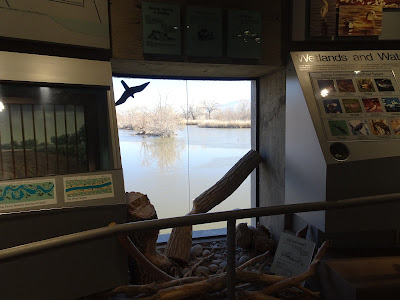
The visitor center is very nice.  It contains interpretive exhibits about the plants, animals, geology, and hydrology of the Middle Rio Grande Bosque ecosystem.  There is a gift shop run by volunteers but they did not have magnets.


There is an observation room and lots of big windows overlooking the same three-acre pond that we could see from the outside viewing area.  

We walked around for about 3 hours before heading back to Sandia House.

The road up to Sandia Crest is quite curvy. 

We arrived around noon and the roads had been plowed and were in good condition. 

We paid our $3 fee and headed to the feeder. 

Sandia Ridge is to the right of Mark.  This is a beautiful area. 


So, did we finally see a Rosy-Finch?

Gray-crowned Rosy-Finch

Yes. We saw one individual of one of the three species. It was pretty disappointing to come all this way to only see one but we have tomorrow morning for another chance.

We did see a couple of other nice birds at this location. 

Dark-eyed Junco (Gray-headed variety)

Hairy Woodpecker

Mountain Chickadee

Even though it was quite cold the sun was shining and there was no wind today.  We stayed on the mountain for a couple of hours before heading back to town for lunch.

While researching things to do in this area, I came across information about a large rock sculpture of a diamondback rattlesnake.  Mark plugged the coordinates into the GPS and we headed out. 

The head is over 6 feet tall.

The body is 200 feet long 

The body is a hollow cylinder 
covered in beautiful rockwork. 

The “rattles” are large boulders.

We were surprised when we reached the end of the road and a second giant rattlesnake. 

Next time:  Are we successful in seeing more Rosy-Finches?  Stay tuned.


Wednesday, February 2, 2022

New Bird, New Magnet, New Mexico

This winter we hoped to visit a couple of different states to look for winter birds. One of those states was New Mexico, but our target birds were slow to arrive, and we'd put the trip off several times. It finally looked like the birds had started to arrive and the weather was going to be pretty decent, so we decided to head on over. 

Day 1:  We had to wait for an A/C and heater checkup at the house, so we got a late start (9:30 am).

It was a long drive, but there was little traffic and the speed limit on IH-10 in West Texas is 80 mph! We didn't take the RV for this trip, so we were able to move along faster than usual. 

Seven hours later we arrived at Bitter Lake National Wildlife Refuge in Roswell, NM. Bitter Lake was established in 1937 to provide winter habitat for migratory birds. 

We have been to this refuge several times but never during this time of year.

We arrived at the visitor center at 4:15 to find that it had closed at 4:00.  This is a no-fee refuge so we got on the auto tour loop and started birding. The big draw at this time of year is cranes and waterfowl. 

There were thousands of Snow Geese coming into the refuge lakes for the night. Most Snow Geese are white, but around 5% are dark.  These used to be considered a separate species and are the symbol for National Wildlife Refuges nationwide: The "Blue Goose". 

Snow Geese

Along with geese, Sandhill Cranes were also coming in for the night. 

Sandhill Cranes

As evening approached the shores of the lakes were filling up with cranes and geese, so we knew that the fly-out the next morning would be fun to watch. 

Sandhill Cranes

By 5:30 pm it was too dark to see anything but this gorgeous sunset.

We headed on to dinner and our hotel for the evening.

Day 2:  The next morning we were at the refuge by sun-up (6:30 am).  It was cold! We headed over to the area of the lake where the cranes and geese had been the previous evening. As the sun rises the birds fly off of the lake and head out to feed. 

The fly-out starts with just a few birds taking off, but eventually builds to the point where thousands of birds are taking off and heading out. 

Hundreds of geese and cranes in the air. 

Once the fly-out had finished, we explored the refuge a bit more. It was cold and windy with a little snow falling but we bundled up for a short trail hike.

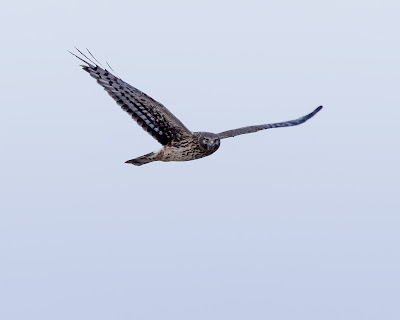
There are plenty of hawks on the refuge, with one of the most common being the Northern Harrier. This used to be called the Marsh Hawk, as they really like to hunt over grassy marshes. 

Northern Harrier hunting

Northern Harrier perched

We enjoyed looks at this pretty little Scaled Quail. 

Scaled Quail

By the time we made it around the auto loop the visitor center was open.

I bought my first magnet of the year:


This refuge is also famous for having recorded over 100 dragonflies and damselflies species.

We left the refuge around 10:30 and headed to our next destination.  The roads had been plowed and sprayed with deicer.

We got to our next destination - and the focal point of the trip - around 2 pm. It was quite chilly! 

19 degrees!  Sorry about the blurry picture.

Sandia Crest is a mountain ridge that, at 10,679 feet, is the highpoint of the Sandia–Manzano Mountains.

Our main goal was to see 3 specific birds: Black Rosy-Finch, Brown-capped Rosy-Finch, and Gray-crowned Rosy-Finch.  They are only here during the winter. We have been watching for them to show up since November. This winter has been slow for birding in many areas. 

There was a surprising amount of snow on the ground (at least to us).

The Sandia Crest House (gift shop/visitor center) is not open in the winter but they do have someone fill the bird feeder a couple of times a week. 

Elevation 10,678

The weather was a little strange.  If it was windy the wind would blow snow out of the trees and it would get dark and foggy.

A few minutes later the wind would stop and it would be sunny and clear (but still cold!). 

We stayed around for about an hour but didn’t see any of the Rosy-Finches.  We did see a few other birds. 

Dark-eyed Junco

Steller's Jay

White-breasted Nuthatch

Our hotel was about an hour away so we decided to head on down the mountain to Albuquerque and check in, warm up, and get something to eat.

Next time: Another chance for a Rosy-Finch.  Did we get lucky?  Follow along and see what we found.

Never miss out on future posts by following us 


Thursday, January 13, 2022

South Llano River State Park

We had a beautiful, sunny winter day here, so decided to head to one of our favorite state parks for a morning of birding. South Llano River State Park is about 90 minutes from our home, and the temperature was 30 degrees when we set out and 32 degrees when we arrived! But the sun was shining and the wind was calm, so it was a perfect day to be out hiking and birding. 

South Llano River State Park features four different birding blinds, each with a water feature and feeders. One of our last volunteer gigs was here, and we were out each morning around 7:00 to make sure that all of the feeders were filled by 8:00. Birders tend to be early birds, and photography is best in the early morning light.

So imagine our thoughts when we arrived at the first blind around 9:00 to find that the feeders had not been filled!  We checked the next two blinds, and they'd also not been filled. We finally saw the hosts making their rounds at around 10:30, so we headed off for a hike to give them a chance to service all of the blinds. After our hike we came back to the blinds to find the birds happily feeding on the freshly placed seed.

We ended up seeing 31 species of birds, and here are some of the better pictures that I got. As always, you can click on a picture to get a larger, clearer version. 

Winter is a great time to see various sparrows in Texas, and while they all seem like LBJ's (little brown jobs) they vary quite a bit. 

Field Sparrow

Fox Sparrow

White-crowned Sparrow

The water features are popular, even in winter. This male House Finch was nice and bright. 

House Finch male

A mixture of peanut butter, lard, and cornmeal appeals to birds that don't eat seed, like woodpeckers. That is what is smeared on this log feeder. 

Ladder-backed Woodpecker male

The Northern Mockingbird is the State Bird of Texas. Not very colorful, but great singers!

Northern Mockingbird

Spotted Towhee male

White-winged Dove

Woodhouse's Scrub-Jay is the western equivalent to the well known Blue Jay. It was interesting to see how their color seemed to change depending on if they were in the shade, or out in the bright sunlight. 

Woodhouse's Scrub-Jay

Woodhouse's Scrub-Jay

 Mark