Tuesday, February 21, 2017

Woodpeckers and Acorns

While we were in Hart Park we saw plenty of woodpeckers. Most common were Acorn Woodpeckers, which have been a favorite of ours for years because they mean that we're in the Davis Mountains of Texas or Southeastern Arizona. Now we can add California to the list.

Acorn Woodpeckers are known for creating community caches of food by drilling holes in trees, poles, and buildings and storing acorns there. We were lucky to see an Acorn Woodpecker actually placing an acorn into a cache!
I've got this excellent acorn...
I need to find the right hole.
In it goes!
Perfect
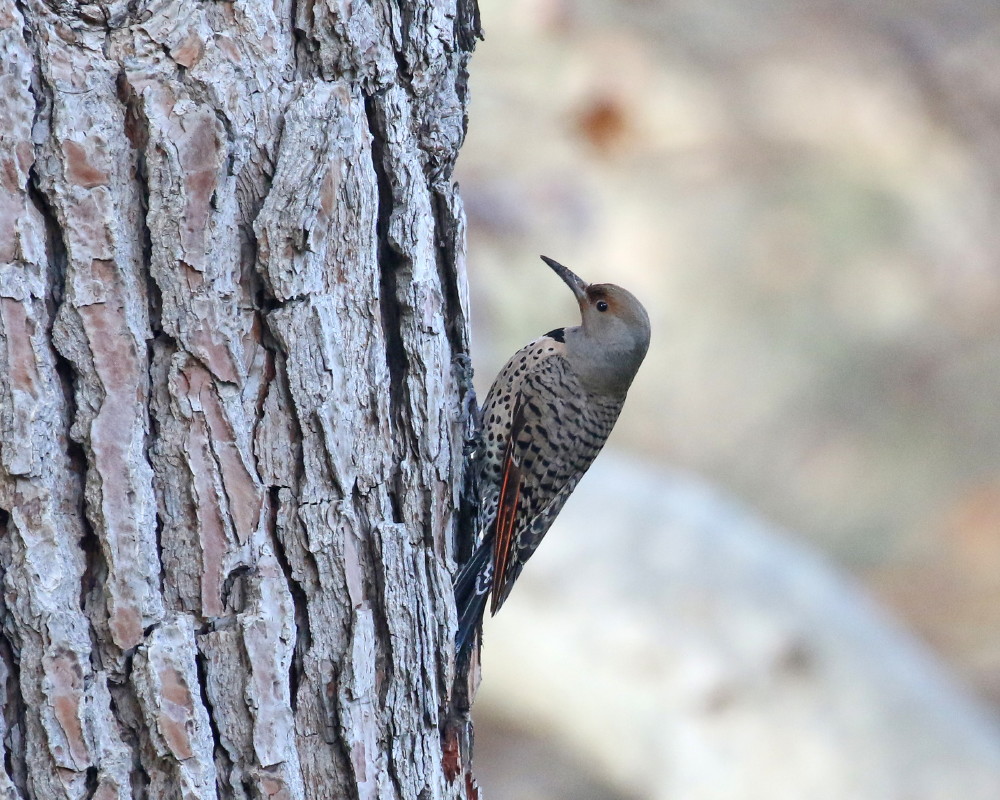
There were also plenty of Northern Flickers.
Northern Flicker
These are the "Red-shafted" variety, which means that their feathers have red shafts. The more eastern birds are "Yellow-shafted".
Northern (Red-shafted) Flicker
We also saw the most western sapsucker, the Red-breasted Sapsucker.
Red-breasted Sapsucker
Red-breasted Sapsucker 
Hart Park turned out to have a couple of pretty nice disc golf courses, and a lot of great birds!

Mark

Monday, February 20, 2017

Birding on the Disc Golf Course

I wanted to add California to the list of states where I'd played disc golf, so while we were in Bakersfield we headed over to nearby Hart Park which sports not one, but two 18-hole courses. The lower course plays along a creek and through some large trees. We played it first and were amazed by the number of birds we saw.
Rose-ringed Parakeet
The most unusual birds that we saw were Rose-ringed Parakeets. These large parakeets are native to Indian and Africa, but escaped birds have established a large breeding population in the Bakersfield area. We saw seven of them high in the trees. I didn't have my big camera but Teri got a couple of shots with hers. 

We went back to Hart Park the next morning to do some "serious" birding. One new bird for us was the California Scrub-Jay. It was formerly considered a Western Scrub-Jay, but the ornithologists have decided that this is now a separate species. 
California Scrub-Jay
We saw several Hooded Mergansers in the creek, including this pair. Such attractive hairdos!
Hooded Merganser pair
Black Phoebes were common along the creek as well.
Black Phoebe
We enjoyed a Belted Kingfisher rattling up and down the creek.
Belted Kingfisher
At one end of the park the creek widened into a small lake. There were several pair of Wood Ducks swimming there. 
Wood Duck pair
After a couple of hours of birding we headed up to play the second disc golf course. This course plays up and down the steep, grassy hillsides. Lots of pretty views and steep uphill/downhill shots. 

Here is a shot from one of the teepads. The basket is down to the right of the barn. There was a 100' elevation drop down to the basket. 

Next: Woodpeckers in the park.

Mark

Sunday, February 19, 2017

Is it a cloud? Smoke? Nope!

Welcome to beautiful Bakersfield, California.  The most polluted city in the US and the second city with the most smog in the US (Los Angeles has the worst smog).

How many layers of smog can you see?
As we drove over the mountains we were stunned to see this much smog!
Bakersfield is in the San Joaquin Valley, a major agricultural area that stretches through much of California.  The San Joaquin Valley contains some of the richest, most productive agricultural land in the country.  But its geography - the valley is surrounded on all sides by mountains - creates a bowl that traps air pollution.  

Most of the 250 miles we drove today were through very stark, dry desert.  Once we started getting close to Bakersfield, the land turned lush and green.  

As we drove by Edwards Air Force Base, we had a couple of jets fly over and we were circled a couple of times by this odd looking plane. 
We are staying at the Orange Grove RV Park, about 10 miles outside Bakersfield.  It’s a nice park that is, you guessed it, in an old orange grove.  This is the view out our front door.

At check-in we were encouraged to “pick the oranges”.  They were very sweet and juicy.
Mark picking the oranges.

Next time; Birding the disc golf course.

Saturday, February 18, 2017

Sing Along!

London Bridge is falling down, falling down, falling down ...

There isn’t a lot to do in the town of Needles, California so we decided to go back into Arizona for a day trip. 

Lake Havasu City is not far from the California/Arizona border.   We’ve never seen the London Bridge so we decided to visit this popular attraction.

Some interesting facts:

In 1967, the Common Council of the City of London began to look for potential buyers for the London Bridge. Lake Havasu City founder and entrepreneur Robert P. McCulloch placed the winning bid of $2,460,000 on April 18, 1968.

McCulloch came by this figure by doubling the estimated cost of dismantling the structure, which was $1.2 million, bringing the price to $2.4 million. He then added on $60,000 – a thousand dollars for each year of his age at the time he estimated the bridge would be reconstructed in Arizona. 


The vintage lamps on the bridge are made from the melted down cannons of Napoleon Bonaparte’s army.
The bridge is 930’ long.
Walking across the bridge.
When dismantled in London, England, each stone was numbered for re-assembly.  If you look carefully, you can see the numbering on many of the stones.
The bridge is home to hundreds of bats.  The inside of the bridge is hollow. When it was rebuilt, it needed to be able to accommodate auto traffic. During the reassembly, a steel framework was faced in granite, rather than using solid granite blocks, which reduced its weight from 130,000 tons to 30,000 tons, while strengthening the structure.

Couples are putting locks on the fence that surrounds the bridge and throwing away the key to symbolize their unbreakable bond.   Apparently these “love locks” are a tradition in Paris.
Hundreds of locks attached to the fence.

We also saw a couple of these authentic red phone booths.
London phone booth.
We walked around a little enjoying the sunshine:
I bought my souvenir magnet:
Then found one I liked better in another gift shop:
I like the ones that have the name of the state on them.


Friday, February 17, 2017

Havasu National Wildlife Refuge

As we travel across the country, Teri and I make it a point to visit any National Wildlife Refuges that are nearby. We were camped in Needles, California and found that Havasu NWR was located just across the Colorado River on the Arizona side.


In the middle of the Mojave Desert the Colorado River is an oasis that attracts birds and wildlife. The refuge protects 30 miles of shoreline from Needles, California down to Lake Havasu City, Arizona. Most of the refuge is accessible only from the river, but we did find a couple of areas that were accessible from land.

It was remarkably difficult to figure out how and where to go at the refuge. There was no visitor center and little information available online. We drove down the west side of the refuge to a small overlook on Beal Lake. The road that crossed the refuge from there was closed to the public, so we had no choice but to backtrack the entire distance and drive all of the way around to the east side!

It seems odd to find White Pelicans in the middle of the desert, but there they were!
White Pelicans

On the east side of the refuge we found a couple of marshy areas with some birds. The Abert's Towhee was common in brushy areas.
Abert's Towhee

There were a few Western Grebes on a small lake, and one came close enough for some good pictures.

To be honest this was one of the more disappointing wildlife refuges we've visited. There just wasn't much for us to see, but it is great that this 30 mile stretch of the Colorado River has been preserved.

On to Lake Havasu and the London Bridge!

Mark

Thursday, February 16, 2017

What's the difference between Arizona and California?


These two stations are within 2 miles of each other. The first is off of the beaten path in Arizona, and the second is just off of the interstate in California. I wonder how many folks would stop at the second station if they knew the first existed??

Hopefully we'll find more reasonable gasoline prices as we make our way north in California!


My Arizona souvenir magnet:


Wednesday, February 15, 2017

Patagonia Lake State Park & Sonoita Creek State Natural Area

We have been in SE Arizona several times but have never made it to Patagonia Lake State Park.
The lake is very pretty.
Patagonia Lake.
We didn’t see a Mountain Lion but we did see several cattle grazing in the park.


Our visit to the park was to go on the Ranger led bird walk and to check for future volunteer opportunities.

The park is pretty typical with close together sites.  While we waited for the bird walk to start, more and more people started showing up.  It didn’t take long for us to realize that this wasn’t our favorite situation.  The walk was going to be 3 hours with 4 leaders in order to accommodate the very large group.
As the group decided which leader to follow, Mark and I decided to slip away and go off by ourselves. 

We saw 43 birds in about two hours.

The park maintained a few hummingbird feeders, and we saw both Broad-billed and Anna's Hummingbirds.
Broad-billed Hummingbird


Anna's Hummingbird

We saw a few desert birds, including a tiny Verdin and the Cardinal-like Pyrrhuloxia.
Verdin


Pyrrhuloxia

And the lake offered a variety of ducks and waterbirds, including a big group of Common Mergansers. The females were all sporting their "bad hair day" feathers, while the males have solid dark heads.
Common Merganser females


Common Merganser male and female

And scratching around on the ground we found a Winter Wren, which is rare for this area.
Winter Wren
Even though we decided that we wouldn't be volunteering here in the near future, we enjoyed our visit.

Birds seen:
Mexican Mallard
Gadwall
Green-winged Teal
Northern Shoveler
Cinnamon Teal
Lesser Scaup
Common Merganser
Ruddy Duck
Pied-billed Grebe
Eared Grebe
Double-crested Cormorant
Virginia Rail
Common Moorhen
American Coot
White-winged Dove
Broad-billed Hummingbird
Anna’s Hummingbird
Gila Woodpecker
Ladder-backed Woodpecker
Black Phoebe
Tree Swallow
Bridled Titmouse
Verdin
Winter Wren
Bewick’s Wren
Marsh Wren
Ruby-crowned Kinglet
Western Bluebird
American Robin
Curve-billed Thrasher
Yellow-rumped Warbler
Black-throated Gray Warbler
Common Yellowthroat
Rufous-winged Sparrow
Chipping Sparrow
Song Sparrow
White-crowned Sparrow
Northern Cardinal
Pyrrhuloxia
Gray Catbird
Red-winged Blackbird
Great-tailed Grackle
House Finch
Lesser Goldfinch