Tuesday, February 13, 2024

Costa Rica 2024 - Day 4

Sunday, January 21, 2024

We met Johan at 5:45 and headed directly for a forest trail. The day was drizzly and overcast, and we were surprised at how little light there was. But we pressed on, eventually seeing some good birds on the gloomy trail, including lifers Middle-American Leaftosser and Chiriqui Quail-Dove. 

Middle-American Leaftosser

As we continued birding it began to rain. This would be the theme for the day. We headed back to the lodge, and ate breakfast at 8:45, Americano for Teri and Huevos Rancheros for me. 

After breakfast we drove to “Papa’s Place”, a nearby private home and garden in La Fortuna. Gerald and Priscilla are an entrepreneurial couple that run a variety of tours and classes, and have only recently opened their home to birders. It turns out that we would see Gerald each of the next two days leading bird tours away from his home. They have a cute little dog that liked to be petted. 

They have a very nice feeder set-up with good perches for photography, and some nice surrounding acreage for forest birds. The feeders were hopping with various tanagers, euphonias, three toucan species, woodpeckers, etc. Not to mention larger birds like guans and chachalacas. 

Collared Aracari

Keel-billed Toucan (the Fruit Loops bird!)

Yellow-throated Toucan

Crested Guan

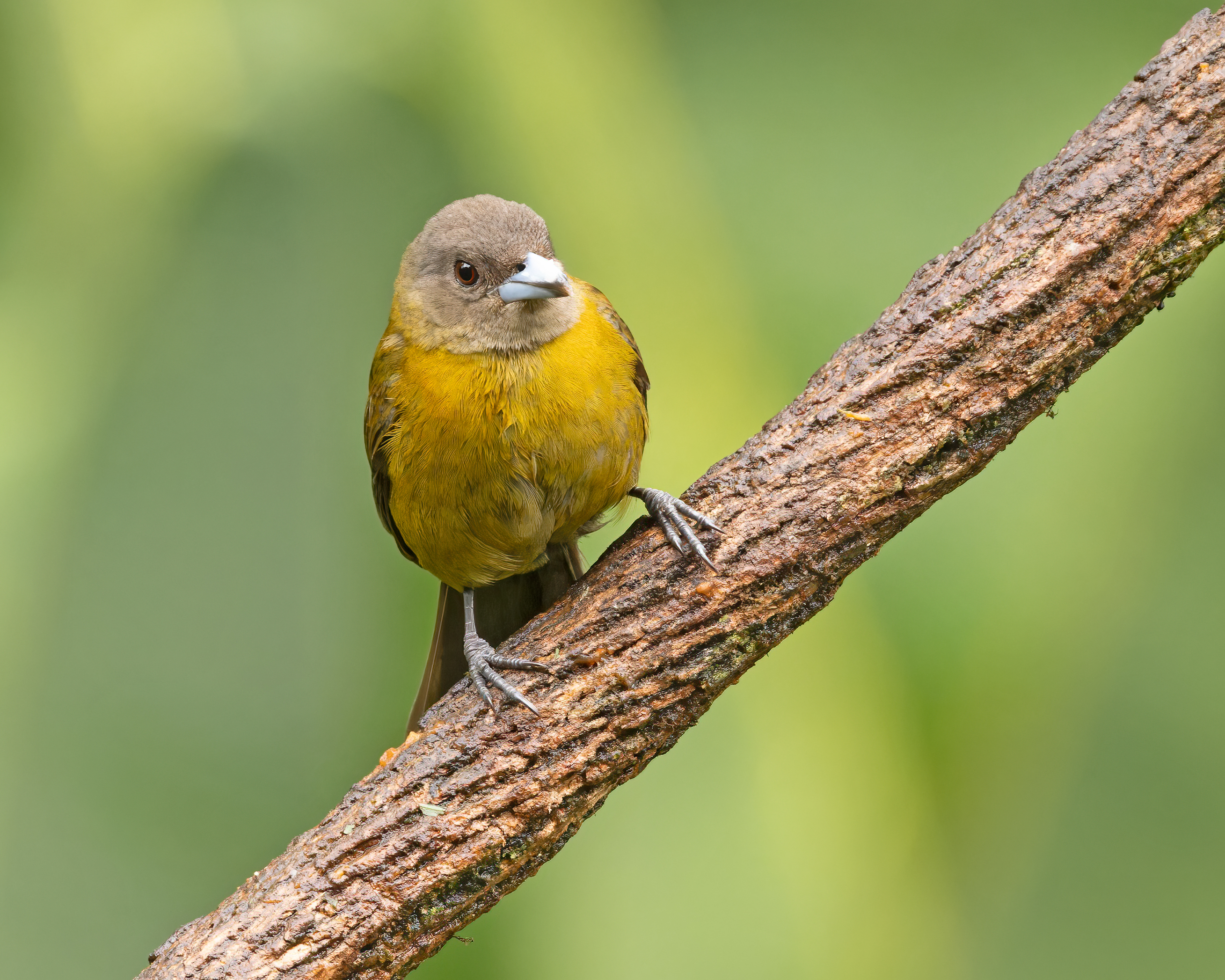
In some of the Tanager and Euphonia species the males and females look very different. Other than the same bluish bill, the Scarlet-rumped Tanagers look completely different. 

Scarlet-rumped Tanager - female

Scarlet-rumped Tanager - male

Yellow-throated Euphonia - male

Yellow-throated Euphonia - female

The difference in the Honeycreepers may not be as dramatic, but they are different as well. 

Green Honeycreeper - female

Green Honeycreeper - male

In some Tanager species the male and female are indistinguishable, at least by us! 

Golden-hooded Tanager

Palm Tanager

Once we’d had our fill of the feeders we walked up into a pasture with scattered trees and a forest edge. We saw five different species of woodpecker, including the scarce Cinnamon and Rufous-winged Woodpeckers. We also saw a White-fronted Nunbird, another hard to find species. 

Cinnamon Woodpecker

Rufous-winged Woodpecker 

White-fronted Nunbird

We returned to the house and were served a traditional Costa Rican lunch prepared by Priscilla, her mother, and a visiting niece. We enjoyed chicken, rice, beans, squash, and fried plantain. All were delicious. We had tamarind juice to drink and a simple sweetened pineapple dessert. It was a fine way to end the morning.


Our hosts in the background

After saying goodbye to Gerald and Priscilla we headed out to Peninsula Road, which runs along a peninsula jutting out into Lake Arenal. It was a rough and rocky road and we came across someone who had broken the suspension on their vehicle!  We spent a lot of time on the road edge calling for a Keel-billed Motmot, but didn’t have any luck. We were really dealing with start-and-stop showers at this point, so were using our travel umbrellas quite a lot. Birding isn’t as enjoyable in the rain, but we hung in there!

Red-lored Parrot eating flowers 

White-throated Magpie-Jay

We made a couple of stops on our way back to Arenal Observatory Lodge, where the big find was a Green-fronted Lancebill, a difficult to find hummingbird that inhabits stream sides. 

Green-fronted Lancebill

It had been a gray, soggy day, but we'd seen a lot of birds and enjoyed our time at Papa's place. 

Next - Moving to CaƱo Negro

Sunday, February 11, 2024

Costa Rica 2024 - Day 3 continued

Saturday, January 20, 2024 continued

After lunch we headed to nearby Sendero Bogarin. This was a location that offered a variety of “eco-activities” like hiking and horseback riding, but most folks visited to take a short nature hike and hopefully see a sloth. 

We started in a wet area next to the parking lot, where we heard a White-throated Crake. This is my “nemesis” bird, as I missed seeing it almost 20 years ago in Panama, where Teri first saw it. It is a difficult bird to find anywhere, and we've missed it over and over again over the subsequent years. So I was thrilled to get a brief look at it moving through the flooded grass in this spot, but wasn’t able to get a photo. Oh well. 

We then paid our entrance fee and watched some very nice feeders with loads of tanagers, honeycreepers, toucans, etc. In addition to adult male Red-legged Honeycreepers, we saw a "teenager" who was just molting into his adult plumage. Like many birds, the young male honeycreepers are colored like females to give them better camouflage. They get their full adult color after about a year. 

Collared Aracari

Orange-chinned Parakeet

Red-legged Honeycreeper - adult male

Red-legged Honeycreeper - immature male

Yellow-throated Euphonia

We then hiked out onto the forest trails, looking first for a Uniform Crake which called consistently for a while but never revealed itself. The rain was more consistent now so we birded much of the time under our umbrellas, which can be awkward. We found a pair of Black-and-white Owls on their day roosts, which were fun to see. 


Black-and-white Owl

We saw a few new species out on the trail, including another hummingbird with an odd name, the Blue-throated Goldentail. The tail doesn't really show up in the picture, but the bright red bill certainly does!

Blue-throated Goldentail

We got our only look of the trip at the gorgeous Crimson-collared Tanager.

Crimson-collared Tanager

When folks on the trails saw us staring up into trees they usually ask if we had a sloth. When we replied no, we were looking at a bird, they'd shake their heads and walk away. Crazy birders...  But we did see one Three-toed Sloth, which we always enjoy. Much easier to get a picture of than birds as they hardly move!

Three-toed Sloth

After birding the trails we sat and watched the feeding area for a bit. In addition to the fruit feeders there was a small pond that attracted some interesting birds. 

Feeder area

Green Heron

Russet-naped Wood-Rail

Yellow-billed Cacique

As we were leaving I spotted the White-throated Crake in the wet area next to the parking area, and was able to get excellent shots. It turned out to be a pair with both visible at some times. 


White-throated Crake

We returned to Arenal in the now constant rain, so instead of attempting any more birding we headed to our rooms to dry out a bit. 

Next - More trails at Arenal, and Papa's Place

Friday, February 9, 2024

Costa Rica 2024 - Day 3

Saturday, January 20, 2024

We met Johan on the raised deck at 5:45 to check out the feeders. The feeders are filled with fruit pieces early in the morning, mostly watermelon and papaya. The biggest birds dominate the feeders first thing, so Great Curassow, Montezuma Oropendola, and Crested Guans fly in early and eat much of the fruit. 

Great Curassow - female

Great Curassow - male

Crested Guan

It is wild to see the turkey-sized Curassows fly up from the ground and land on the rather slender feeding perches, but they do so fearlessly. About ten Coati gathered below the feeder to feast on the fruit being dropped by the birds. One Coati climbed the adjacent tree and was trying to figure out how to jump onto the feeder, but finally gave up. We were glad, as the fall would have likely seriously injured or killed it. 

After watching the feeders for about 15 minutes we headed across a suspension footbridge to check out some large garden areas, hoping for Black-crested Coquette. We did see a female perched in some flowers but not a mature male. We had good looks at Pale-billed Woodpecker as well a Golden-olive Woodpecker.  

Black-crested Coquette - female

Pale-billed Woodpecker - female

It was foggy/drizzly much of the time, which made it a little difficult for photography and even seeing birds well. 

Mark & Johan on the trail at Arenal

We did see a few hard-to-find forest birds, like Ocellated , Dull-mantled, Zelodon’s and Spotted Antbirds. The pictures aren't great because of the mist and darkness, but you can see what they look like!

Ocellated Antbird

Spotted Antbird - male

We came in for breakfast at 8:30, and went back out at 9:00, setting out on the “Los Monos” trail. By now we were seeing a little more rain, so had to break out our umbrellas now and then, and worry about keeping binoculars and cameras dry. 

Staying (mostly...) dry

We saw a nice variety of birds as the morning went on, including both a male and female White-ruffed Manakin, a Wedge-billed Woodcreeper and the National Bird of Costa Rica, the rather plain Clay-colored Thrush.  

White-ruffed Manakin - female

Wedge-billed Woodcreeper

Clay-colored Thrush

At about 11:00 it started to rain more heavily, so Johan took us to a sheltered spot overlooking a beautiful section of garden. He’d been told that the male Black-crested Coquette had been seen feeding here the past couple of days, so we sat down in some dry chairs and waited. The garden was full of Rufous-tailed Hummingbirds, which can be particularly aggressive towards smaller species like the coquettes. But finally a beautiful mature male showed up and fed on verbena blooms that were directly in front of where we were sitting. These are tiny little hummingbirds that move constantly, but I was able to get some great pictures, and we headed back to the lodge. 


Black-crested Coquette - male

We decided to drive to the nearby town of La Fortuna for lunch as it would put us close to our afternoon birding area. We stopped at La Rana Roja (The Red Frog) and had a good lunch. We're not really sure why the restaurant was named "The Red Frog" but it was catchy and the food was good. 


Nachos - Messy but delicious

Next - Sendero Bogarin