Thursday, March 10, 2011

Birdwalks

This is one of our fun 'jobs' here at Santa Ana:

We are now leading bird walks on Tuesday (8:30 and 1:00), Wednesday (8:30) and Sunday (8:30). We walk about 1 1/2 miles and are out 2 - 2 1/2 hours. The walks are slow, there isn’t much elevation change, and we see quite a few birds.

Before the walk starts Mark and I arrive at the visitor center early and put out bird food. We go through a lot of oranges every week. The oranges are donated by a local grower. We also put out black oil sunflower seed and a peanut butter-cornmeal mixture.


Mark starts the walk at the feeding station by the visitor center. We see a lot of the more colorful birds here (Green Jay, Altamira Oriole, Great Kiskadee, Red-winged Blackbird.

We have had as few as one person show up for the walk, and as many as 25. Any more than about 12 makes it hard for the folks near the back to hear Mark or see the birds.


Mark gives a lot of information about the flooding that took place this summer and explains that the refuge was under water for over two months. He also points out a lot of the trees and tells how they are used by the people in the area.


A few of the trails are still under water and are closed. Some of the trails have been re-worked and are very nice.


Our walk takes us under some beautiful, Spanish moss covered trees.


We end the walk at the butterfly gardens by visitor center.


The walk isn’t all about birds.


Rose-bellied Lizard

Indigo Snake

Wednesday, March 9, 2011

HMANA

The Hawk Migration Association of North America (HMANA) is a membership based organization committed to the conservation of raptors through the scientific study, enjoyment, and appreciation of raptor migration.


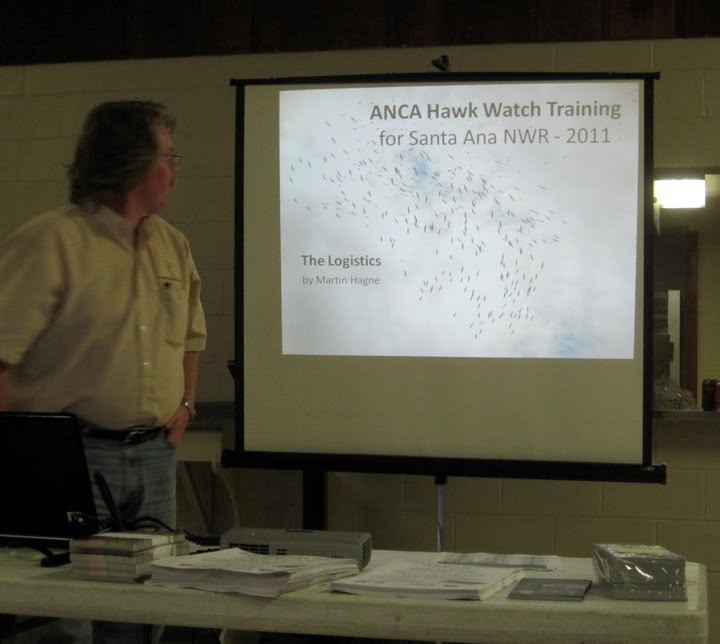
We had a full day of training today. Mary Gustafson taught our Hawk Watch training class. Here at Santa Ana the Hawk Watch is from March 15th to April 15th.
Today we learned the essential mechanics of hawk migration and hawk watching. We studied Accipiters, Buteos, Falcons, Vultures, and Kites. We learned their silhouettes, size, shape, color and pattern in flights. It was a lot of information to absorb in one day!

After lunch we walked around the Camp Thicket area of Estero Llano Grande State Park.


Martin Hagne of Valley Nature spoke for about an hour on the protocols for the hawk watch record keeping (estimating numbers, etc).

We are still amazed at the wonderful training we are getting here at Santa Ana.

Mark has signed up to help with the hawk watch count once a week and he will get a day of training in the field tomorrow.

From eNature.com: Every fall, millions of birds fly south to spend the winter in sunny places with mild climates and plentiful food. Most smaller birds migrate under the cover of darkness, stopping to fuel up on insects or seeds by day and using the stars to guide them at night. Hawks, by contrast, are diurnal (daytime) migrants; they depend on currents of rising warm air to lift them to high altitudes where they glide on their broad wings without flapping, thereby conserving energy. During these flights, hawks use their keen eyesight to recognize landmarks, follow landforms that provide rising thermals, and steer a course north to their summer homes. In some places these migrating hawks gather in huge numbers, and people gather to watch them with binoculars and data sheets in the phenomenon known as hawk watch.

Counting hawks during migration is more than a competitive pursuit for list-oriented birders. The data collected at hawk watches helps experts monitor the health of various ecosystems. Because hawks are top predators — that is, they occupy the top of the food chain — they're very sensitive to changes that affect prey species. Comparing hawk numbers from year to year reveals trends that offer insight into the well-being of the environment in both the breeding and wintering areas.

But more than simply counting hawks, there's the spectacle of it all. Standing atop a ridge while hundreds of hawks circle and stream past is an unforgettable experience, which helps explain why people return to these sites day after day and hawk watch programs across the country attract volunteers by the dozens.

Tuesday, March 8, 2011

Soup Dump Party

Ever hear of a Soup Dump party?

It sounded pretty strange to us but we decided to go to the volunteer get together.

Once a week the volunteers get together and either go out to eat or bring a dish to the volunteer building which has a kitchen and screened-in porch. We haven't gone to many of the get togethers, mostly because of other commitments, but we always enjoy visiting with the other volunteers. It's a great way to learn about other volunteer experiences and places to visit. The volunteers here are an interesting group and, for the most part, very well traveled. It's fun to hear about their experiences and we get good information and ideas about possible places for us to volunteer.

Anyway, back to the soup dump. We were told to bring a canned vegetable and whatever we wanted to drink. We arrived a little early so there weren't a lot of people yet but it didn't take long for most of the other volunteers to show up.


A good start to the soup. We brought hominy.

What we found out is that the host started the base of the soup dump which consisted of browned hamburger meat and beef broth. Everyone that came in gave him their canned vegetable and he opened it and 'dumped' it in the meat/broth mixture.


A one pot meal!

Believe it or not, it was quite good!


Soup line (crackers and rolls too).

After we ate several people stayed to play games.


It was a very fun evening.

Sunday, March 6, 2011

Awesome creatures!

Today was our first Sunday morning bird walk. We started at 8:30 with 3 people then added another couple of people while on the trails. A few other folks came and went with us too. The highlight was a beautiful Yellow-throated Warbler. Mark didn’t carry his camera on the bird walk so no photo. But, we got great looks. We had a Black-and-White Warbler and really good scoped looks at a Green Kingfisher. We also saw a few snakes.

We had been hearing the Northern Beardless-Tyrannulet but hadn’t gotten a look at him. Since no one on the walk was in a hurry to get back to the visitor center we stayed out till almost noon. We never did see the Tyrannulet but we had a nice walk with perfect weather.

It’s pretty nice working half a day! Thursdays and Sundays will be half days (mornings) for us from now on.

After our Santa Ana bird walk we went to lunch then headed to Frontera to see what birds we could find there. It was a little late in the day for birding but we did see some awesome critters, and a few birds too!


Brown Anole (non-native)
Native to Cuba. Unlike the Green Anole it does not change color. It sheds its skin several times a year.
Males are territorial and ward off intruders by elaborately bobbing their head while displaying the dewlap.


Fatal Metalmark
Metalmarks (family Riodinidae) are so named for the small metallic markings on many. They live mainly in the tropics. Only about twenty species are resident north of Mexico. They usually perch with their wings open. Most appear to be quite sedentary, rarely straying from their place of birth.


We got great looks at this Green Kingfisher.


Chachalaca's are always fun to see (and hear)!


I've been wanting to see a Two-Barred Flasher for a long time. This one perched right in front of us.


Flashers are large, brightly marked skippers of tropical forest regions. They have been found mainly in extreme southern Texas.

Saturday, March 5, 2011

When is a Turkey Vulture not a Turkey Vulture?

On our day off we went birding in Santa Ana. It seems funny to some people that, since we lead bird walks at Santa Ana, we would go there on our days off and bird. But, there is a big difference in leading others and finding birds for others to see. When it’s just Mark and me we can take all the time we want and we’re not trying to get several people up to the spotting scope before the bird flies away.

So, off to Santa Ana we went. We walked a little bit different route than we do on the official bird walks. We walked all the way around Willow Lakes then down to Pintail Lakes. At Pintail Lakes there is a trail to the left that leads back to the visitor center. The trail has been flooded the whole time we have been here but the water has started receding a bit and we were able to walk down the trail about 100 yards. We walked to where the trail was flooded and were looking across the ponds when this ‘Turkey Vulture’ flew by. It took a few seconds for the mind to register that this ‘Turkey Vulture’ has a yellow bill and yellow legs and beautiful banding on its tail.

The answer to the question “When is a Turkey Vulture not a Turkey Vulture”?

When it’s a Zone-tailed Hawk!


Juvenile Zone-tailed Hawk

The Zone-tail looks remarkably like a Turkey Vulture. It may be overlooked even by birders who are searching for it. This close resemblance may fool other creatures as well. Small animals learn to ignore the abundant and harmless Turkey Vultures, and they may fail to notice an approaching Zone-tailed Hawk until it is too late.

They eat mostly lizards, mammals, and birds. In some areas they specialize on certain large lizards, such as spiny lizards or collard lizards. In other areas, birds are the main items in their diet.

In hunting, it soars and circles like a Vulture. When it spots prey, it continues to circle as before, but gradually moves off to the side and lower. As soon as it’s screened from the prey animal by cover, the hawk turns and makes a direct, powerful attack, taking the prey by surprise. Sometimes it makes steeper direct dives without this kind of stealthy approach.


Zone-tailed Hawk

Turkey Vulture

Both Turkey Vultures and Zone-tailed Hawks fly with a pronounced dihedral (the upward angle of the wings).

Wednesday, March 2, 2011

Aplomado Falcon Success Story

Once on the verge of extinction, the Aplomado Falcon now hunts and nests on the coastal prairies of the Laguna Atascosa National Wildlife Refuge. Since the first speedy falcon took wing in 1993, more than 900 falcons have been released in the Lower Rio Grande Valley.

We found this beautiful bird sitting on a fence post on our way into Laguna Atascosa.


Tuesday, March 1, 2011

Gardens

Half way through our volunteer time here at Santa Ana we had a meeting with the volunteer coordinator. This is a way for her to find out if we are enjoying ourselves, if there is something we would rather do, etc.

Some of the things we brought up are that we would like to lead an extra bird walk on Wednesday morning (in addition to the two bird walks we lead on Tuesday). We would also like to have some additional work in the gardens. The butterfly garden was in very good condition when we arrived in January so there hasn’t been a whole lot to do except water and pull a few weeds. After the freeze a couple of weeks ago we cut back a lot of plants but for the most part the garden doesn’t take a lot of work.


We cut these plants back after the freeze.
They are growing fast now!


The butterfly gardens have really taken off in the last week.


Very nice pond in the butterfly garden.

Sooo, be careful what you ask for! We did get the go-ahead to lead the Wednesday morning bird walk, we were also asked to lead a Sunday morning bird walk AND, in addition to that, we were given 50 trees and 100 shrubs to plant at the volunteer RV campground!

The plants are small, about 10 inches.


150 very small plants!

The ground here is hard as concrete! We have to water the area to be planted, water it again, hoe out the grass, dig the hole, put in the plant, fill in the hole, apply mulch, water and water and water. (I say ‘we’ but the only thing I do is move the sprinkler around, Mark does everything else).


Watering the ground before digging.


One little plant in the ground.


Lots of mulch needed. After the end of this month there won't be anyone here to water these little plants till next October!


Four shrubs planted. Can you see them?

It will take a few years but will really look nice when the plants grow a little larger.