Sunday, February 20, 2011

Sharp-shinned Hawk


We were sitting in the RV and heard quite a crash and a lot of wing flapping in the tree right outside our door. Mark took his camera out and found this guy (or gal) hanging out. Apparently he wasn't too successful in grabbing a house sparrow!

The Sharp-shinned Hawk is the smallest bird-hunting Accipiter hawk*(10" to 14"). Like most hawks, the female is larger than the male. The Sharp-shinned Hawk is also the most migratory. It breeds in Alaska and Canada and winters in Panama. It mostly eats small birds by approaching stealthily through dense cover, then bursting forth with incredibly swift flight to capture prey in its talons.

Numbers dropped in mid-20th century, possibly as a result of DDT and other pesticides in the food chain, then recovered somewhat through early 1980s. Since that time, counts of migrants in the east have shown significant declines again.

* There are 3 Accipiter hawks in the US (Accipiter is the genus). They primarily feed on birds. They are: Sharp-shinned Hawk, Cooper's Hawk, and Northern Goshawk.

Sunday, February 13, 2011

Estero Llano Grande

Mystery bird:

Can you spot and identify the bird? Answer below.


We went out to Estero Llano Grande today. It’s a quick, easy drive from Santa Ana. There is always lots to see. Here are a few of the birds we saw:


Peregrine Falcon (missing a few tail feathers)


Cinnamon Teal


Blue-winged Teal


Neotropic Cormorant

This is something interesting we noticed. This Ring-necked duck would raise and lower his crown.


Ring-necked Duck (crown raised)


Ring-necked Duck (crown flat)

Once again he mystery bird:


Did you spot it?


Common Pauraque

This was a great find! There was a sign along the trail that said please be quiet and do not disturb the day sleeping Pauraque. There was also some brush piled up next to the trail We looked into the area hunting for the Pauraque only to find them (2 of them) about 2 feet off the trail!

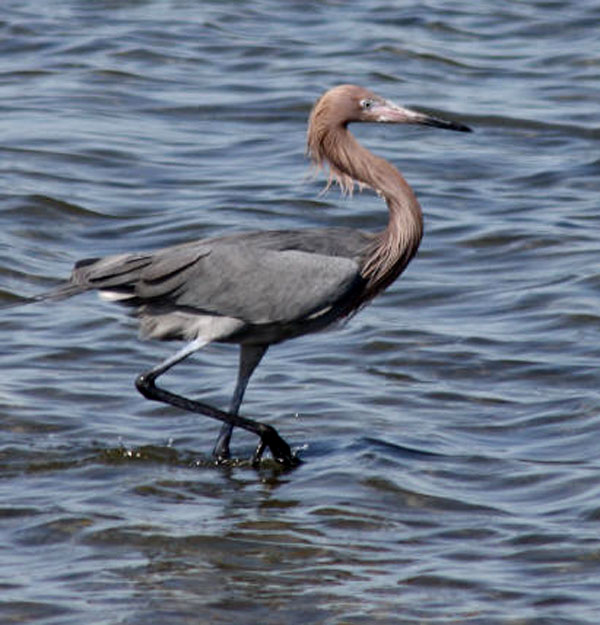
Reddish Egret

The Reddish Egret was nearly extirpated from the United States by plume hunters prior to 1900.

It is a conspicuously long-legged, long-necked wader of coastal regions, more tied to salt water than any of our other herons or egrets.


It has a wide variety of feeding behaviors. Often very active, running through shallows with head titled to one side, suddenly changing direction or leaping sideways.


May stand still and partly spread wings.


Schools of small fish may instinctively seek shelter in the shaded area thus created.


Primarily eats small fish, also frogs, tadpoles, and crustaceans.

Saturday, February 12, 2011

S. Padre Island World Birding Center (Part 1)

This is part 1 of a 3 part series of our visit to S. Padre Island.

From freezing weather on Thursday to almost perfect weather today!

We drove out to S. Padre this morning. We went to the World Birding Center ($10 entry for both of us). The birding Center is on 50 acres and is at the southern tip of the world’s longest barrier island.


Queen Isabella Causway


Pile of Turtles


White-tailed Hawk


White-tailed Hawk (Juvie)


Yellow-rumped Warbler


Common Yellowthroat

S. Padre Island WBC - Part 2

More birds from our trip:

Mystery duck:


Answer revealed in Part 3!


Blue-winged Teal


Semipalmated Plover


Pied-billed Grebe


Killdeer


Common Moorhen (Juvie)


Common Moorhen


Blue-winged Teal (Female)


American Coot

S. Padre Island WBC - Part 3

Even more birds from our trip:

Did you guess the mystery bird?
One more look at the mystery bird. Answer below.


Pintails in flight


White Ibis


Tricolored Heron


Little Blue Heron


Greater Yellowlegs


Great Egret


Forster's Tern


Mystery bird turned out to be a rail!
Did you guess a Juvie Purple Gallinule?
This 'swamp hen' has strong legs and long toes, it runs on open shorelines, walks on floating lily pads, and clambers through marshes and waterside trees.

Sunday, February 6, 2011

World Birding Centers

There are 10 World Birding Centers in the Rio Grande Valley. We visited two of them today with our friends Sharon and Rick.

The first place we stopped at was the Hidalgo Pumphouse. The museum was closed but the grounds were open and we were able to walk around.

The museum grounds have been planted with the types of native trees, shrubs and flowers that attract Valley birds and butterflies.

Click on picture to enlarge:


Smokestack

The grounds are landscaped with native trees and shrubs.

The Boarder fence runs along the back of the property.

There wasn't a lot to see at the Pumphouse so we drove on to the Edinburg Wetlands World Birding Center. Since it was Sunday, the interpretive center was closed but the grounds were open and we were able to walk around.

In March of 2003, the Edinburg Scenic Wetlands and World Birding Center was the first World Birding Center to open.

The center sits on 40 acres within a city park, near the City of Edinburg. Built on re-claimed farm fields and next to the city's effluent & floodwater ponds.

The entire 40 acres can be accessed by winding paths and waterside observation platforms.


Observation Platform

Edinburg Wetlands

American Coot

Least Grebe

Northern Shoveler

Common Moorhen

Great Kiskadee

Spotted Sandpiper