Wednesday, June 15, 2011

Aroostook County

Here are some birds we've seen around the area:


Cedar Waxwing


Black-throated Green Warbler


Chestnut-sided Warbler


Hooded Merganser


Gray Catbird


Double-crested Cormorant


American Goldfinch

Tuesday, June 14, 2011

Unauthorized User

We had an unauthorized user this morning in the shower house (Room 3 to be precise). I escorted the perpetrator from the building after obtaining mugshots.
Mark


Spotted Salamander (Ambystoma maculatum)

[It is about 6–7.5 inches long. There are two rows of yellowish orange spots that run from the top of the head (near the eyes) to the tip of the tail. These rows are uneven. The underside is slate gray and pink.
The spotted salamander usually makes its home around hardwood forest areas. They must have a pond as that is the only place they can lay eggs. A spotted salamander spends most of its time beneath ground level. It hides in moist areas under moss-covered logs or stones. These salamanders are secretive and will only exit their underground home on warm rainy nights in Spring, to breed and hunt.
They have the ability to drop their tails, to distract predators. If a predator of the spotted salamander manages to dismember a part of a leg, tail, or even parts of the brain/head, then it can grow back a new one, although this takes a massive amount of energy.]

Mars

The scale model of Mars is 2.9 inches

Mars is about half the diameter of Earth but has a more Earthlike atmosphere than any other planet in the System. The atmosphere is fairly thin and includes clouds. The surface may have small amounts of ice and water. Mars has two moons, Phobos and Deimos, but they are too small to be readily visible at the scale of the Solar System model.


Monday, June 13, 2011

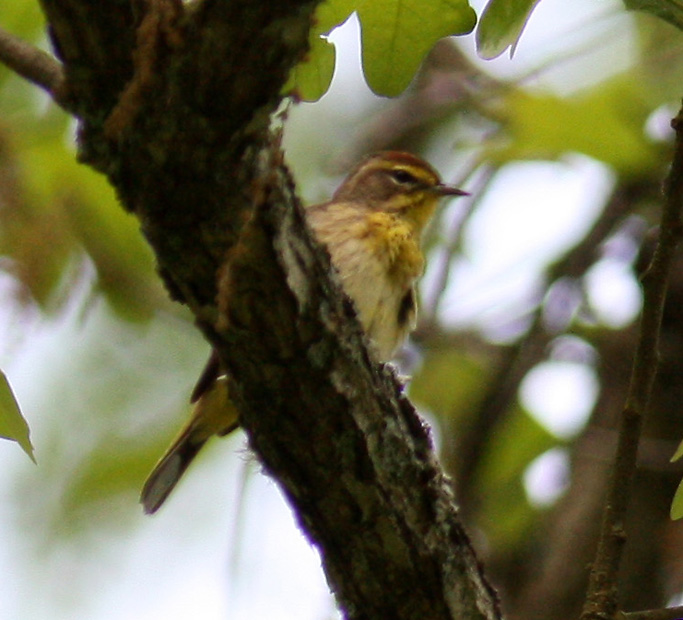
Quiz: Palm Warbler

Which of these four habitats would you not find a Palm Warbler:

1. Palm Trees
2. Bogs
3. Coastal Marshes
4. Hardwoods


Bog - Kouchibouguac National Park, Canada


Marshes - Magee Marsh, Ohio


Hardwood - Natchez Trace State Park, Tennessee

[Palm Warbler (Dendroica palmarum) A bird of thickets and open areas, usually seen low or on the ground. Many Palm Warblers spend the winter in the southeastern US, especially in Florida, where they may be seen near palm groves but not up in the palms themselves.

They breed in sphagnum bogs with scattered cedar, tamarack, and spruce trees. The western race also breeds in dry pine barrens of boreal forests with ground cover of blueberry, bearberry, and sweet fern. In migration, they frequent old hedgerows, edges of streams and ponds, overgrown fields, and open pastures.]

Answer: # 1. You would not find a Palm Warbler in a Palm Tree! Did you get it right?

Sunday, June 12, 2011

The Earth and Moon


The scale model of the Earth is 5.5 inches. The scale model of the Moon, 1.5 inches.


Earth, with the Moon at the appropriate distance.

Earth is perhaps the System’s most interesting planet. Atmospheric conditions allow for frequent movement of water in all three phases - solid, liquid, gas. The planet’s 23-degree tilt produces seasonal changes. Continents move about over a somewhat liquid interior. Mountains form and are eroded. Earth makes 365 1/4 rotations in one revolution about the Sun.

Earth has a rather large moon which revolves about the planet in 29 1/3 Earth days. The Moon also has a 29 1/3 day rotation, so that one hemisphere always faces the Earth. The Moon does not have an atmosphere.

Saturday, June 11, 2011

In the park

We're getting ready for the Aroostook State Park Birding Festival that is on the 18th. Mark has been asked to lead birdwalks - starting at 5:00 a.m.! He has been walking around the park with his camera and keeping track of what birds are around.


Northern Parula


Red-breasted Nuthatch


Hairy Woodpecker

Friday, June 10, 2011

Eh! Canada - Part 1

Canada Moose Count: 1
Canada Black Bear Count: 1
Canada Bird Count: 50
Canada Life Birds: 1

For our two days off (Tuesday and Wednesday), we headed to Canada. It’s about a 3 1/2 hour drive to Kouchibouguac National Park. When we got to the border crossing, the Border Patrol officer asked where we were going. Kind of hard to say when you can’t pronounce the name of the place! He told us how to pronounce it then asked us a bunch of questions about where we were from, what we were going to do in Canada and checked out our passports. Then, before he gave us back our passports he again asked us what the name of the park we were going to - Ugh! We still can’t pronounce the name.


Border crossing into Canada


On the way to the park we saw both a Black Bear and a Moose along the highway. No pictures-as soon as we stopped to get the camera out, they took off.


Can you believe it - they have a Texas stop sign here in Canada:


After lunch we headed straight to the Park.


Kouchibouguac means “river of long tides”.
“koo-she-boo-gwack"

This is our first look at the Atlantic Ocean:


On average, the Atlantic is the saltiest major ocean.

[In the North Atlantic the currents move clockwise, the most famous being the Gulf Stream which carries warm water from the Caribbean and the Gulf of Mexico up the east coast of the USA and then out across to the British Isles.]


The Piping Plover builds its nest on the ground by digging a small depression and lining it with pebbles and shells. The eggs become easy targets for predators such as foxes, gulls, crows and ravens. Measures have been put into place to give the piping plover a fighting chance. The nesting areas are closed from May to July to keep humans away. Wire mesh fencing is placed around nests to prevent predators from getting at the eggs while allowing the birds to leave and entry. Video cameras are set up near nesting sites.

The Piping Plovers are just starting to arrive and the fencing is being put up to close off the nesting area.


There are ten trails in the park. A couple of them were closed due to a storm last December. We hiked the rest of the trails and part of one of the closed trails. Although it isn’t a very ‘birdy’ park, we did see a few nice birds.


Snake


Brown Creeper


Black-throated Blue Warbler


American Redstart


Moose Droppings

This isn't the end - keep on reading Canada - Part 2